EV charger installation in Warwickshire
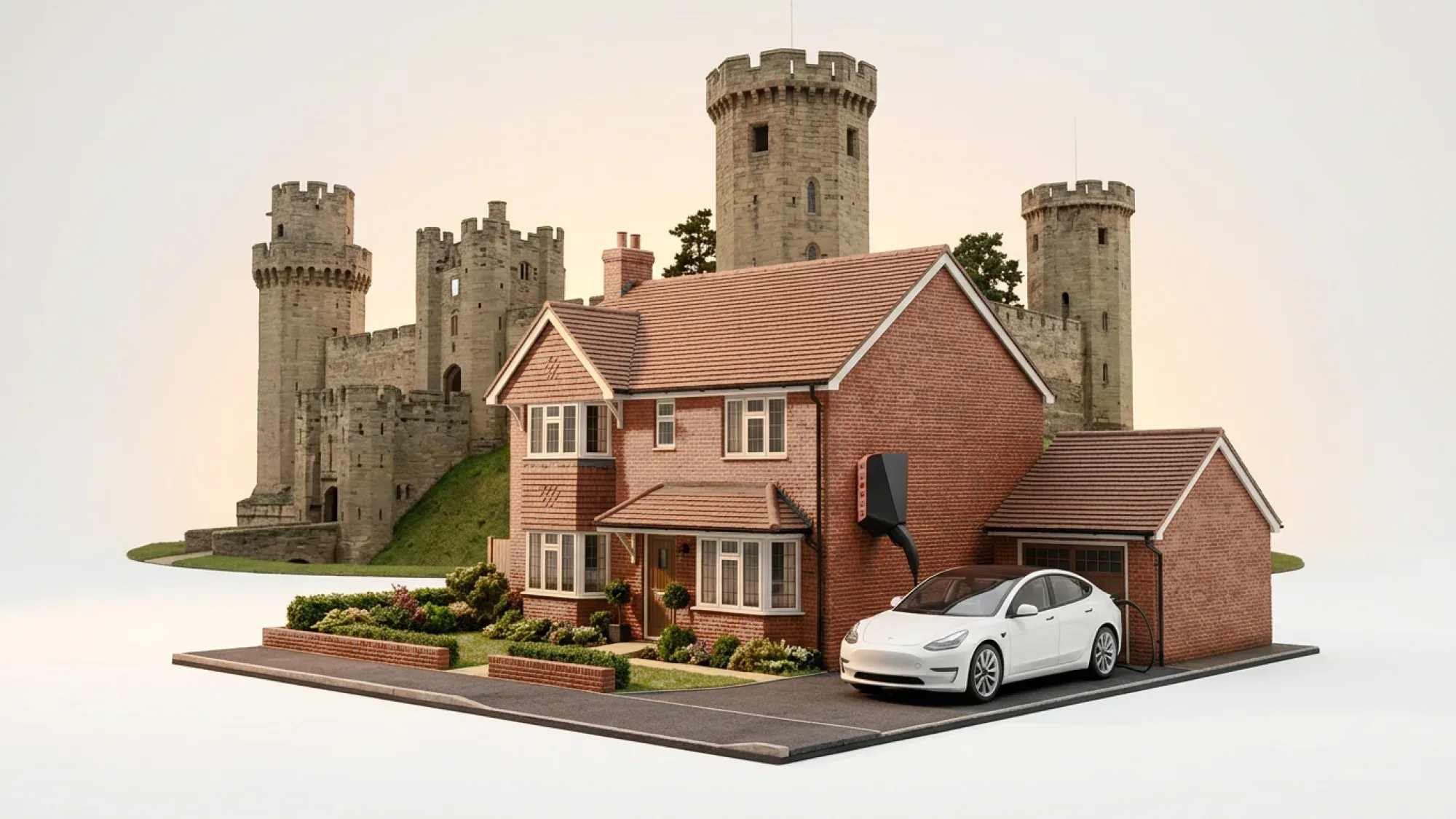
Installing an electric vehicle (EV) charger at home in Warwickshire offers convenience and potential cost savings. However, navigating the local specifics, grants, and installation process can be complex. From historic market towns like Warwick and Stratford-upon-Avon, with their mix of period properties and modern developments, to the county's more rural areas, property types and local grid infrastructure present unique considerations for EV charger installation. This guide will empower you with the knowledge to confidently approach home EV charger installation, connecting the dots between local specifics, grants, and smart energy management.
Warwickshire's EV charging landscape
Understanding the local context is crucial when considering a home EV charger in Warwickshire. The county's diverse housing stock, which includes a significant proportion of post-war homes and a higher-than-average number of flats in some districts, alongside rural properties, means that installation requirements can vary widely.
Why home charging matters in Warwickshire
Home charging provides the most convenient and often the most cost-effective way to power an EV. For Warwickshire residents, this means waking up to a fully charged vehicle, avoiding queues at public charging points, and taking advantage of cheaper off-peak electricity tariffs. With the number of electric vehicles in Coventry and Warwickshire projected to increase significantly by 2030, home charging will play a vital role in meeting demand and supporting the transition to electric transport.
Understanding Warwickshire's local energy grid
Warwickshire sits within the "West Midlands" electricity distribution region. The local Distribution Network Operator (DNO) for Warwickshire is National Grid Electricity Distribution1. This organisation is responsible for the local power lines and infrastructure that deliver electricity to your home. In the event of a power cut, residents should dial the free national number 105, which will route them directly to their local DNO.
The DNO notification process for Warwickshire homes
Any new home EV charger or solar/battery grid connection in Warwickshire requires notification to National Grid Electricity Distribution (chargers via the ENA connect-and-notify route; solar or battery systems under G98/G99)2. This ensures that new connections are safely integrated with the local distribution network and do not negatively impact grid stability.
What is the ENA connect-and-notify process for EV chargers?
G98/G99 are engineering recommendations for connecting electricity generation or storage to the grid2; a home EV charger is instead notified to the DNO under the ENA connect-and-notify process, with prior approval needed where the property's total demand exceeds 60amps. Your installer typically handles this notification to National Grid Electricity Distribution, ensuring your new charger integrates smoothly with Warwickshire's local network.
The specific process depends on the power output of your charger. Where the property's total demand stays at or below 60amps, your installer can fit the charger first and notify the DNO within 28 days. Installations that push demand above that level require an apply-to-connect application, which needs approval from the DNO before installation can proceed. Your qualified installer in Warwickshire will be familiar with these requirements and manage the necessary paperwork on your behalf.
Navigating EV charger grants and costs in Warwickshire
The initial outlay for an EV charger and its installation can be a barrier for some, but government grants and local initiatives can help reduce these costs.
OZEV EV Chargepoint Grant eligibility
The Office for Zero Emission Vehicles (OZEV) offers grants to help with the cost of buying and installing chargepoints for electric vehicles3. The EV Chargepoint Grant for renters and flat owners provides up to £500 towards the cost of installing a chargepoint at your property. To qualify, you must own and live in a flat, or rent and live in any residential property, and have private off-street parking. There is also an EV Chargepoint Grant for households with on-street parking, which provides up to £500 for those installing a cross-pavement solution.
It is important to note that a typical homeowner who owns and lives in a house with private off-street parking is generally not eligible for any current domestic chargepoint grant. For all current domestic OZEV chargepoint grants, the customer applies for the grant themselves via the GOV.UK eligibility/application page. The OZEV-authorised installer's role begins only after the customer's application is approved.
Potential costs of installation
The total cost of installing a home EV charger in Warwickshire can vary significantly. Factors influencing the price include:
- The type of charger: Different brands and power outputs come at different price points. Fuse offers the Easee One charger, which delivers 7.4 kW.
- The complexity of the installation: This includes the distance from your fuse box to the charging point, the need for trenching, or upgrades to your home's electrical supply.
- Electrical work required: Older properties, common in parts of Warwickshire, might need consumer unit upgrades to safely accommodate an EV charger.
- Installer fees: These will vary between OZEV-approved electricians operating in the area.
While grants help, it's crucial to get detailed quotes from several qualified installers to understand the full cost for your specific property. You can learn more about the factors affecting the overall cost of an EV charger installation by reading our guide on how much is an EV charger.
Local on-street charging initiatives (LEVI)
For residents without off-street parking, local councils can install on-street residential chargepoints through the government's On-Street Residential Chargepoint Scheme (ORCS), which is now part of the broader Local Electric Vehicle Infrastructure (LEVI) fund4. This scheme aims to increase the availability of public charging infrastructure, particularly in residential areas where home charging isn't feasible. The LEVI fund supports local authorities in England to plan and deliver charging infrastructure for residents without off-street parking.
The home EV charger installation process
Installing an EV charger is a multi-step process that requires careful planning and professional execution.
Finding a qualified installer in Warwickshire
Choosing the right installer is paramount for a safe and efficient EV charger installation. Always select an OZEV-approved electrician who is qualified to install EV charging points. Look for local companies with a strong reputation in Warwickshire, as they will have a better understanding of local regulations and the DNO's requirements. For more information on finding the right installer, see our guide on EV charger installation.
Pre-installation checks and requirements
Before installation, your chosen electrician will conduct a thorough assessment of your property. This typically involves:
- Assessing your electrical supply: Ensuring your home's fuse box and wiring can safely handle the additional load of an EV charger.
- Checking parking arrangements: Confirming you have dedicated off-street parking where the charger can be safely installed.
- DNO notification: Your installer will handle the necessary connect-and-notify or apply-to-connect notification to National Grid Electricity Distribution.
- Grant eligibility confirmation: If you are applying for an OZEV grant, your installer can help confirm your eligibility, but you will need to complete the application yourself via GOV.UK.
What to expect on installation day
On the day of installation, the electrician will typically:
- Install the charging unit: Mounting the charger in the agreed-upon location.
- Connect to your electrical supply: Wiring the charger to your consumer unit, potentially requiring a dedicated circuit.
- Test the system: Ensuring the charger is functioning correctly and safely.
- Provide a demonstration: Showing you how to use your new charger and its smart features.
- Issue certification: Providing an electrical installation certificate and completing any final DNO notifications.
The process usually takes a few hours, depending on the complexity of the installation.
Maximising your EV charging with smart technology
Smart charging technology can transform how you power your EV, offering greater control and potential cost savings.
Benefits of smart EV chargers
Smart EV chargers offer more than just a power outlet; they connect to your home's Wi-Fi, allowing you to control and monitor your charging remotely via an app. Key benefits include:
- Scheduled charging: Set your EV to charge during off-peak hours when electricity is cheaper.
- Load balancing: Prevent overloading your home's electrical supply by adjusting charging speeds based on other household electricity use.
- Energy monitoring: Track your EV's energy consumption and associated costs.
- Integration with renewable energy: Some smart chargers can prioritise charging when your home solar panels are generating surplus electricity.
Integrating smart charging with your home energy
For Warwickshire homeowners, integrating smart EV charging with overall home energy management can lead to significant efficiencies. Apps, like Fuse's, allow you to monitor your total home energy consumption, including EV charging, giving you a clearer picture of your energy usage and greater control. This transparency helps you make informed decisions about when and how to charge your vehicle.
Optimising costs with time-of-use tariffs
Time-of-use (ToU) tariffs are electricity plans that offer different prices for electricity at different times of the day. By combining a smart EV charger with a ToU tariff, you can automatically charge your EV when electricity rates are at their lowest, typically overnight. Fuse's app and smart tariffs can help Warwickshire residents optimise their EV charging costs and energy usage, making the most of these cheaper periods. Fuse also offers 24/7 human customer support for energy-related queries, providing peace of mind for Warwickshire residents managing their home energy, including EV charging.
Choosing the right EV charger for your Warwickshire home
Selecting the ideal EV charger involves considering your vehicle, your property, and your charging habits.
Types of EV chargers available
Home EV chargers primarily come in two types:
- Untethered: These chargers have a universal socket, allowing you to use your car's charging cable. This offers flexibility if you own multiple EVs with different connector types.
- Tethered: These chargers have a cable permanently attached, often preferred for convenience as you don't need to retrieve your car's cable each time.
Many home chargers are "fast" chargers, designed to fully charge an EV overnight, and the Easee One that Fuse installs delivers 7.4 kW of power.
Key features to consider
When choosing an EV charger, look for:
- Compatibility: Ensure it's compatible with your EV's charging port.
- Power output: Consider your charging needs and the capabilities of your home's electrical supply.
- Smart features: Remote control, scheduling, and energy monitoring capabilities are essential for optimising costs.
- Safety features: Overcurrent protection, earth fault detection, and weather resistance are crucial.
- Future-proofing: Consider chargers that can be updated via software to support new features or grid services.
Future-proofing your home charging setup
As EV technology evolves, future-proofing your home charging setup is a smart move. This involves choosing a charger that can adapt to future energy demands and grid services. Opting for a smart charger from a reputable brand that offers software updates ensures your investment remains relevant. Consider your potential future energy needs, such as adding solar panels or a home battery, and how your EV charger could integrate with these systems for even greater energy independence and cost savings. You can find more details on selecting the right charger in our guide to picking the right home EV charger.
Ready to take control of your home energy and EV charging? Fuse Energy makes it simple with clear pricing, real-time usage data, and 24/7 human customer support. Our smart tariffs are designed to help you make the most of cheaper off-peak electricity, reducing the cost of charging your EV. Switching is quick and easy, so you can start saving and managing your energy smarter today.
References
- National Grid. Distribution area - Search
- UK Government. How to register energy devices in homes or small businesses
- UK Government. Electric vehicle chargepoint grants
- UK Government. Apply for Local Electric Vehicle Infrastructure (LEVI) funding
Disclaimer
For the avoidance of doubt, this article is provided for informational purposes only and is not intended to constitute legal or financial advice. The author and/or Fuse Energy shall not be responsible for any losses arising out of any reliance on the information contained herein.