EV charger installation Portsmouth
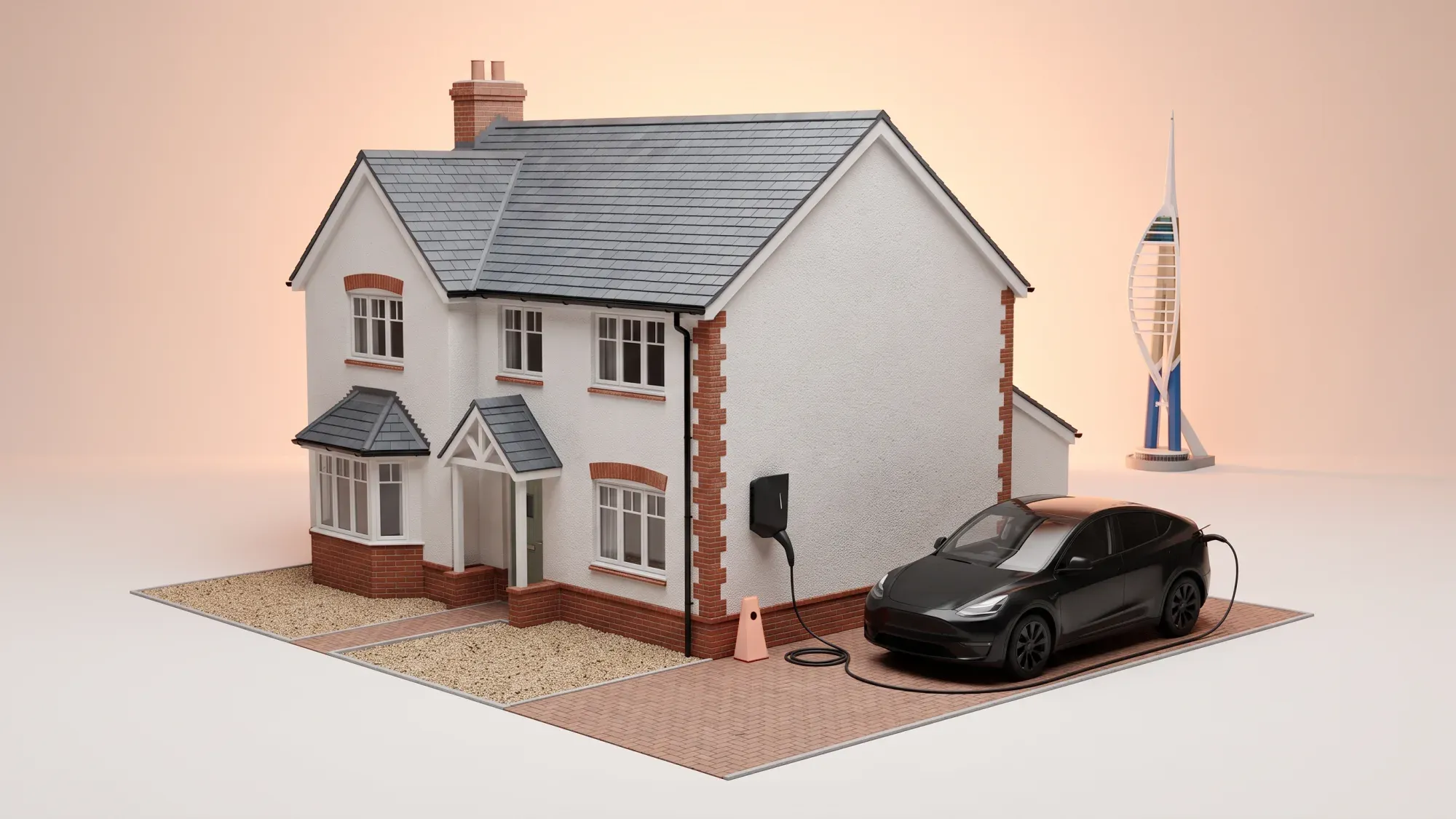
For homeowners in Portsmouth, installing an EV charger is a practical step towards embracing electric vehicles and gaining greater control over home energy. Portsmouth, with its mix of historic Victorian terraces, modern developments, and seaside flats, presents specific considerations for EV charger installation, particularly regarding off-street parking availability. This guide will walk you through the process, from understanding local regulations to choosing the right installer and maximising your charging efficiency.
Why install an EV charger at home in Portsmouth?
Convenience and cost savings
Charging an electric vehicle at home offers unparalleled convenience, allowing you to top up your battery overnight without relying on public charging infrastructure. This can also lead to significant cost savings, especially when utilising smart tariffs that offer cheaper electricity during off-peak hours.
The environmental advantage
Opting for an EV charger at home supports a cleaner environment by reducing reliance on fossil fuels. By integrating your charger with smart energy management, you can further optimise your energy consumption, contributing to a more sustainable future.
Understanding EV charger installation in Portsmouth
Portsmouth's energy landscape: price cap and DNO
Portsmouth is located in the "Southern England" electricity distribution region. This regional classification means that electricity unit rates and daily standing charges for residents are influenced by Ofgem's price cap, which is updated quarterly. Your local Distribution Network Operator (DNO) is responsible for maintaining the electricity network and ensuring a reliable power supply to homes in the area. If you experience a power cut, you can dial the free national number 105, which routes directly to your DNO. You can find your specific DNO using the Energy Networks Association (ENA) 'Find my network operator' tool.
The DNO notification process for home chargers
When installing a new EV charger at your home in Portsmouth, your installer will handle the DNO notification process with your DNO. This process ensures that new grid connections, such as those for EV chargers, are safely integrated into the local electricity network. For smaller installations, up to 3.68kW per phase, the connect-and-notify process applies, which is a simpler notification. For larger or more complex systems, the apply-to-connect process requires pre-approval from the DNO before installation.
Property considerations for installation
Before installing an EV charger, assess your property's suitability. This includes evaluating your parking arrangements to ensure you have dedicated off-street parking where the charger can be safely installed. You'll also need to consider your property's existing electrical supply capacity to determine if any upgrades are necessary. For a comprehensive overview of the process, consider reading a guide on EV charger installation.
Costs, grants, and funding for Portsmouth residents
Typical installation costs
The cost of installing an EV charger in Portsmouth can vary depending on the type of charger, the complexity of the installation, and any necessary electrical upgrades to your property. While a standard installation might be straightforward, properties with older wiring or those requiring significant cable runs will incur higher costs. To understand the potential expenses, it's helpful to know how much an EV charger costs.
OZEV EV chargepoint grants
The UK government offers several OZEV (Office for Zero Emission Vehicles) EV chargepoint grants1 to help reduce the cost of installing a home EV charger. These grants are available until 31 March 2027.
- The EV Chargepoint Grant for renters and flat owners provides up to £500 towards the cost of buying and installing a chargepoint. To be eligible, you must own and live in a flat, or rent any residential property, and have private off-street parking.
- The EV Chargepoint Grant for households with on-street parking also provides up to £500 towards the cost of installing a chargepoint. Eligibility requires you to own or rent the property, have only on-street parking, and be installing a cross-pavement solution (such as a charging gully).
You must use an OZEV-authorised installer, and the charger must be from an approved list. The customer applies for the grant themselves via the GOV.UK eligibility/application page; the installer's role begins only after the application is approved.
Who is eligible for the OZEV EV chargepoint grants?
There are two main domestic OZEV EV chargepoint grants. The EV Chargepoint Grant for renters and flat owners is available to those who own and live in a flat or rent any residential property with private off-street parking. The EV Chargepoint Grant for households with on-street parking is for those who own or rent a property with only on-street parking and are installing a cross-pavement solution. Both provide up to £500 towards an approved smart home charger, provided an OZEV-authorised installer carries out the work.
On-street charging solutions
For Portsmouth residents without off-street parking, the EV Chargepoint Grant for households with on-street parking supports the installation of chargepoints at properties where a cross-pavement solution is being used. This initiative aims to make EV charging accessible for those who rely on street parking, which is particularly relevant in urban areas like Portsmouth where off-street parking can be limited.
Choosing your EV charger and a local installer
Types of home EV chargers
Home EV chargers typically come in two main types: 'untethered' (where you use your car's charging cable) and 'tethered' (with a cable permanently attached to the unit). Most modern chargers are 'smart' chargers, offering features like scheduled charging and remote control via an app. For more details on selecting the right one, explore guides on choosing the right home EV charger.
Key considerations for installer selection
When selecting an EV charger installer in Portsmouth, prioritise those with local expertise and a strong understanding of DNO requirements. Look for installers who are OZEV-authorised if you plan to apply for a grant. A reputable installer will conduct a site survey to assess your property's electrical capacity and parking arrangements, providing a detailed quote.
Accreditations and local expertise
Ensure your chosen installer holds relevant accreditations, demonstrating their competence and adherence to safety standards. Local expertise is crucial as it means they are familiar with Portsmouth's specific DNO requirements and can navigate the ENA connect-and-notify process efficiently.
Maximising your EV charging with smart technology
The role of smart meters and tariffs
Connecting your EV charger to a smart meter is key to unlocking significant cost savings. Smart meters enable you to access smart energy tariffs, which offer variable electricity prices throughout the day. This allows you to charge your EV during off-peak hours when electricity is cheaper, often overnight.
Optimising charging for cost and convenience
With a smart meter and a compatible tariff, you can use your EV charger's smart features to schedule charging sessions automatically. This optimisation ensures your car is charged when electricity prices are lowest, without you needing to manually intervene. It transforms EV charging from a simple necessity into a strategic 'power play' for your home energy.
Future-proofing your home energy
Integrating an EV charger with smart technology is a step towards future-proofing your home energy setup. Fuse Energy enables Portsmouth residents to make a 'power play' by installing an EV charger, giving them control over their energy future and challenging the scarcity mindset. Fuse integrates EV charger installation with smart meters and advantageous tariffs, offering a holistic home energy solution that simplifies energy management. Fuse's approach allows Portsmouth homeowners to optimise charging costs through smart technology and gain transparency and control over their energy use, supported by 24/7 human customer support.
References
- UK Government. Electric vehicle chargepoint grants
Disclaimer
For the avoidance of doubt, this article is provided for informational purposes only and is not intended to constitute legal or financial advice. The author and/or Fuse Energy shall not be responsible for any losses arising out of any reliance on the information contained herein.