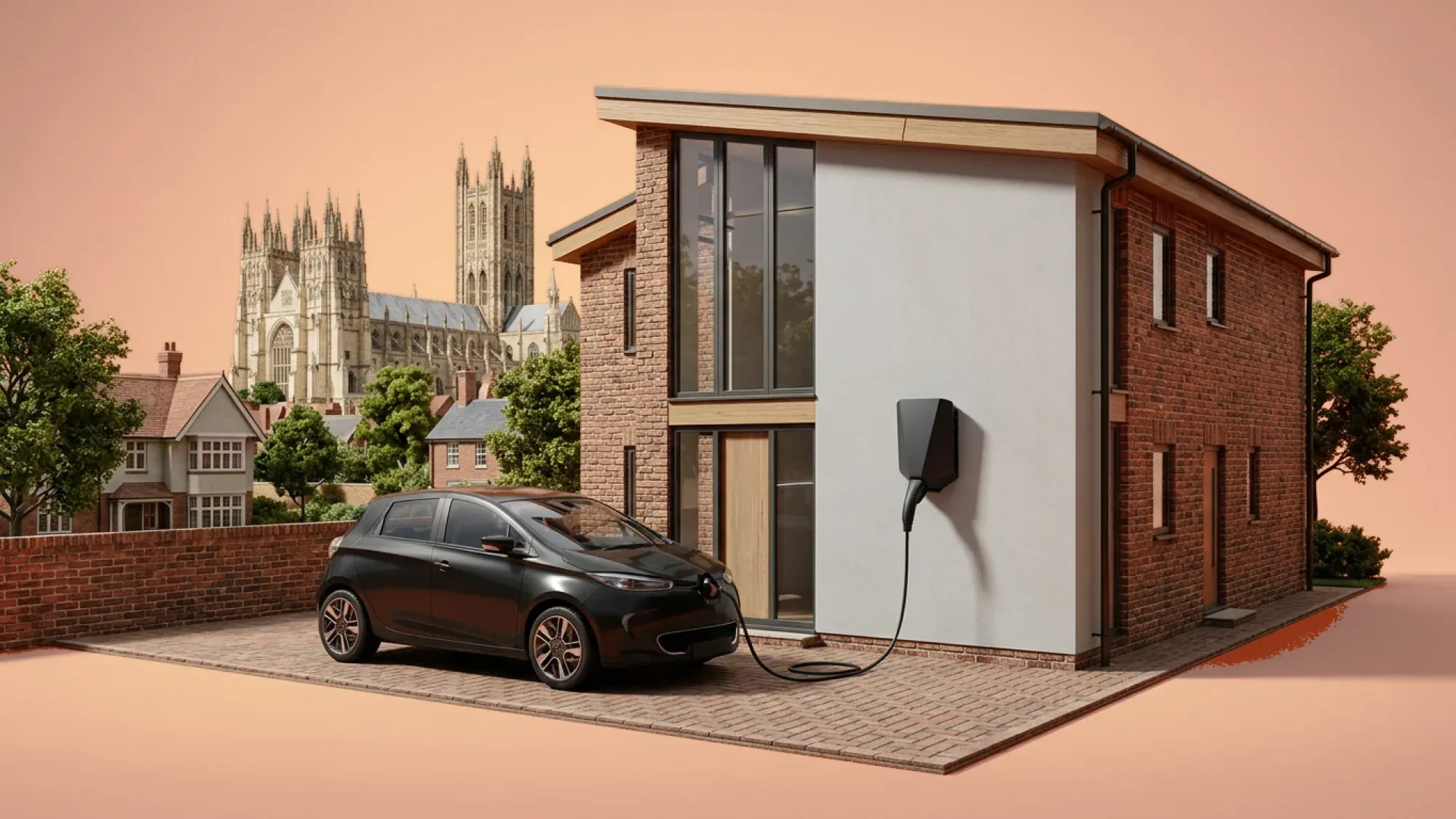
Installing an electric vehicle (EV) charger at home offers convenience and future-proofs your property. For residents in Canterbury, understanding the local energy landscape and available support is key to a smooth transition to home charging. This guide will help you navigate the process, from choosing the right charger to understanding grants and installation requirements.
Why install an EV charger at home in Canterbury?
Choosing to install an EV charger at your Canterbury home brings several advantages, enhancing your daily routine and potentially increasing your property's appeal.
Convenience and cost savings
Having a dedicated EV charger at home means you can top up your vehicle overnight, waking up each day with a full "tank." This eliminates the need for frequent trips to public charging stations, saving you time and hassle. Furthermore, home charging can be significantly more cost-effective, especially when utilising smart tariffs that offer cheaper electricity rates during off-peak hours.
Boosting your property value
As electric vehicles become increasingly common, a home EV charger is becoming a desirable feature for potential buyers. It signals that your property is equipped for modern living and sustainable transport, potentially increasing its market value and appeal in Canterbury's competitive housing market.
Understanding EV charger types and compatibility
Before installation, it is crucial to understand the different types of EV chargers and their compatibility with your vehicle and home's electrical system. For more general information on home EV chargers, including hardware basics and smart tariffs, explore our EV charger guide.
Tethered vs untethered chargers
EV chargers typically come in two main types: tethered and untethered. A tethered charger has a cable permanently attached, ready for use. An untethered charger, on the other hand, requires you to use your vehicle's charging cable, offering more flexibility if you own multiple EVs with different connector types.
Smart charging features
Modern EV chargers often include smart charging capabilities. These features allow you to schedule charging sessions, monitor energy consumption, and even integrate with smart home systems. Smart charging can optimise costs by automatically charging your EV when electricity is cheapest, such as during off-peak hours.
Power ratings and charging speed
EV chargers are available with different power ratings for home use. A common choice for many homes offers a good balance between charging speed and electrical infrastructure requirements. The charging speed will depend on your car's onboard charger capacity and the power output of your home charger. For more details on choosing the right charger for your needs, consider our guide on how to pick the right home EV charger.
Grants and funding for EV chargers in Canterbury
Several government initiatives are in place to help reduce the cost of installing an EV charger, making it more accessible for Canterbury residents.
The OZEV EV chargepoint grant
The Office for Zero Emission Vehicles (OZEV) provides financial support towards the cost of purchasing and installing a home charging point through specific grant schemes1. The EV Chargepoint Grant for renters and flat owners provides up to £500 towards a home charger for eligible flat owner-occupiers and people in rental accommodation. To be eligible, you must live in a rented property or own a flat, have dedicated off-street parking, and own or lease an eligible electric or plug-in hybrid vehicle.
On-Street Residential Chargepoint Scheme (LEVI)
For Canterbury residents without off-street parking, the On-Street Residential Chargepoint Scheme (LEVI) supports local councils in installing public chargepoints. This initiative aims to ensure that everyone has access to convenient EV charging, regardless of their property type. The LEVI fund helps local authorities in England to work with the chargepoint industry to improve the rollout of local charging infrastructure, particularly for those without driveways.
The EV charger installation process in Canterbury
Installing an EV charger involves several steps, from initial assessment to final testing, with specific considerations for Canterbury's local network. For a comprehensive overview of the process, including what to expect during the site survey and installation, you can refer to our detailed guide on EV charger installation.
Initial assessment and site survey
A qualified, OZEV-approved installer will first conduct a site survey to assess your home's electrical capacity and determine the best location for your charger. This assessment ensures your electrical system can safely support the new load and identifies any necessary upgrades.
DNO notification: UK Power Networks
A critical step in the installation process in Canterbury is notifying the local Distribution Network Operator (DNO), which for this area is UK Power Networks. New home EV charger installations are notified to UK Power Networks under the ENA connect-and-notify process. This is a regulatory requirement to ensure grid safety and capacity, and your chosen installer will typically manage this notification on your behalf.
What is the ENA connect-and-notify process for EV charger installation?
The connect-and-notify process is a UK regulatory requirement for connecting generating equipment, including EV chargers, to the electricity grid. The connect-and-notify route applies where the property's total demand stays at or below 60amps, with the DNO notified after installation. Your installer notifies UK Power Networks, Canterbury's DNO, to ensure grid safety and capacity.
Installation and testing
Once all approvals are in place, the installer will proceed with the physical installation of your EV charger. This includes mounting the unit, running the necessary cabling, and connecting it to your home's electricity supply. After installation, the charger will be thoroughly tested to ensure it is functioning correctly and safely.
Finding a reliable EV charger installer in Canterbury
Choosing the right installer is paramount for a safe and efficient EV charger installation.
Key qualities of a good installer
Look for installers with a strong track record, positive customer reviews, and comprehensive insurance. They should be able to clearly explain the installation process, provide a detailed quote, and offer after-sales support.
Checking OZEV approval and certifications
Ensure your chosen installer is OZEV-approved. This accreditation confirms they meet the government's standards for quality and safety, and it is a prerequisite for accessing the OZEV EV chargepoint grant. Installers should also comply with IET Wiring Regulations (BS 7671).
Getting quotes and comparing services
Obtain multiple quotes from different OZEV-approved installers in the Canterbury area. Compare not only the price but also the scope of services included, such as the type of charger, warranty, and any additional electrical work required.
Integrating your EV charger with home energy management
An EV charger is more than just a power outlet; it's a key component of a modern, efficient home energy system.
Smart tariffs and off-peak charging
By integrating your EV charger with smart tariffs, you can significantly reduce your charging costs. Smart tariffs offer cheaper electricity rates during off-peak hours, typically overnight, allowing your EV to charge when demand on the grid is lower and energy is more abundant. This smart approach to charging gives you more power to play with your home energy.
Solar panels and battery storage integration
For those looking to further enhance their home energy independence, an EV charger can integrate seamlessly with solar panels and home battery storage. Charging your EV using electricity generated from your own solar panels maximises your use of renewable energy and further reduces your reliance on grid electricity. Any excess solar generation can be stored in a battery for later use, including charging your EV.
Canterbury's energy landscape: South East England price cap
Canterbury falls within the South East England electricity distribution region. Ofgem sets the electricity price cap, which includes regional variations across Great Britain and is updated quarterly. This means that unit rates and daily standing charges can differ from other regions. The average UK home uses around 2,700 kWh of electricity per year. Understanding these regional specifics helps you make informed decisions about your energy consumption and potential savings.
For the avoidance of doubt, this article is provided for informational purposes only and is not intended to constitute legal or financial advice. The author and/or Fuse Energy shall not be responsible for any losses arising out of any reliance on the information contained herein.