How are solar panels made?
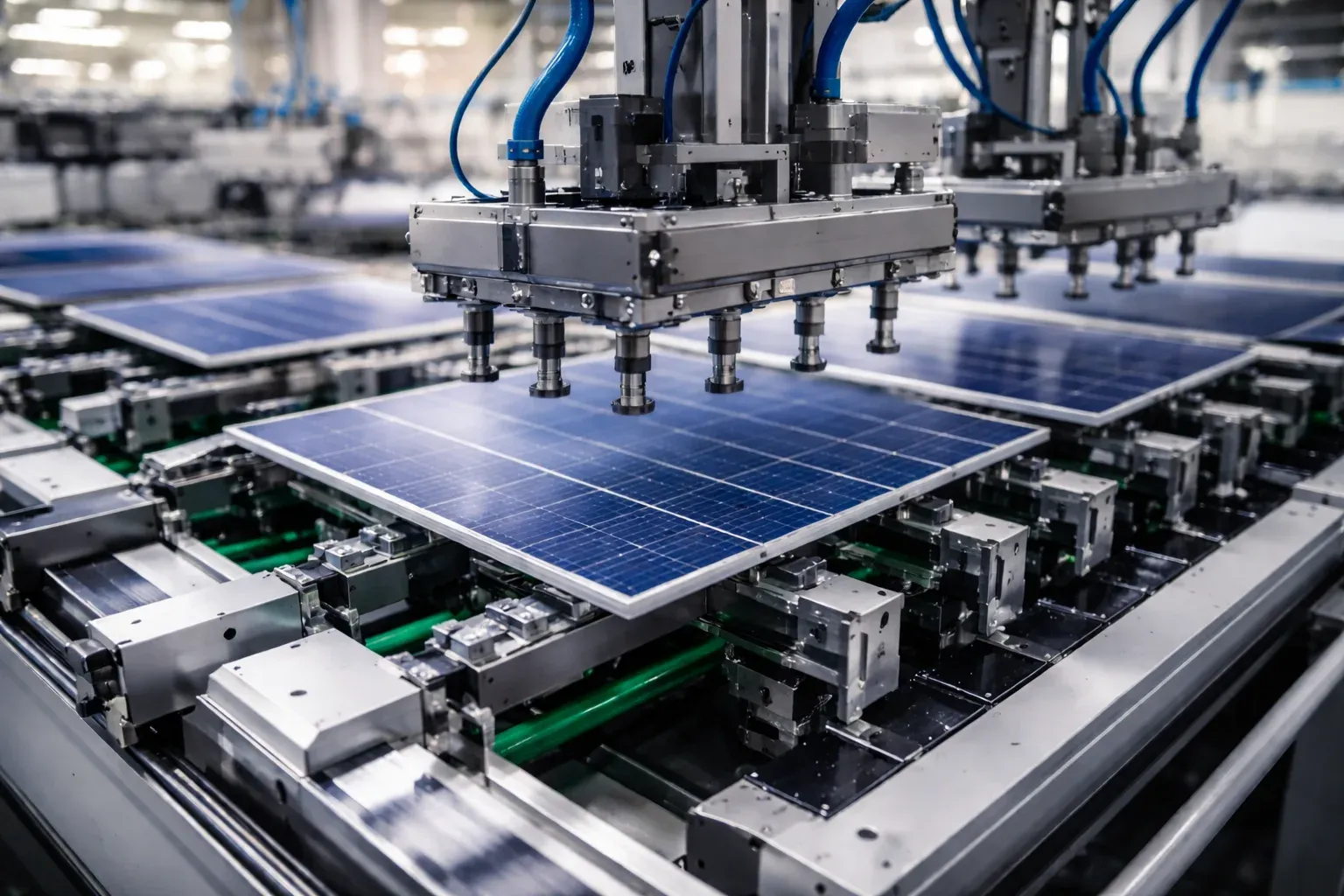
Solar panels convert sunlight into electricity through a complex manufacturing process. This journey transforms raw materials, primarily silicon, into highly efficient photovoltaic (PV) modules. This intricate process, from purifying quartz sand to assembling the final panel, is fundamental to building a future powered by abundant, clean energy.
The core components of a solar panel
A solar panel is more than just a flat sheet; it is an engineered system designed to capture and convert solar energy reliably for decades. Understanding its basic building blocks reveals the ingenuity behind this technology.
What is a photovoltaic cell?
At the heart of every solar panel is the photovoltaic (PV) cell. These small, usually square, cells are responsible for converting light directly into electricity through the photovoltaic effect. When photons from sunlight strike the cell, they excite electrons, creating an electric current. Individual cells are then connected to form a larger solar panel, or module.
Key materials used in solar panel construction
The construction of a solar panel relies on several key materials, each serving a critical function:
- Silicon: The primary semiconductor material for most solar cells, typically derived from quartz sand. It is chosen for its ability to efficiently convert light into electricity.
- Glass: A durable, transparent front layer that protects the solar cells from environmental damage while allowing maximum sunlight to pass through.
- Encapsulant (EVA): Ethylene Vinyl Acetate (EVA) sheets are used to laminate and seal the solar cells between the glass and the backsheet, protecting them from moisture and physical shock.
- Backsheet: A protective polymer layer on the rear of the panel that insulates the electrical components and shields against moisture and UV degradation.
- Aluminium frame: Provides structural integrity, protects the edges of the panel, and facilitates mounting.
- Junction box: Located on the back of the panel, it houses the bypass diodes and electrical connections, ensuring safe and efficient power output.
From sand to silicon wafer: the first steps
The journey of a solar panel begins with one of the most abundant elements on Earth: silicon. However, transforming raw silicon into a usable material for solar cells is an energy-intensive and precise process.
Silicon purification and ingot growth
The primary raw material for silicon solar panels is silica (silicon dioxide), commonly found in quartz sand. This sand undergoes a multi-stage purification process to achieve the high purity required for semiconductor applications. Initially, it is heated in an arc furnace to produce metallurgical-grade silicon. This is then further refined through chemical processes, often involving distillation, to create polysilicon, which is typically 99.9999% (6N) to 99.999999% (8N) pure. This ultra-pure silicon is then melted and carefully grown into large, cylindrical crystals called ingots. These ingots can be either monocrystalline (a single, continuous crystal structure) or multicrystalline (composed of many smaller crystals).
Slicing into wafers
Once the silicon ingots have cooled and solidified, they are incredibly dense and brittle. These ingots are then precisely sliced into extremely thin wafers, typically between 160 to 200 micrometres thick, using wire saws. The thinner the wafer, the more cells can be produced from a single ingot, reducing material waste and cost. These wafers are the foundational substrate for individual solar cells.
Crafting the solar cell: the heart of the panel
With silicon wafers prepared, the next stage involves transforming them into functional solar cells capable of generating electricity. This requires precise chemical and physical treatments.
Doping and etching for electrical properties
To create the electrical field necessary for the photovoltaic effect, silicon wafers are "doped" with impurities. One side is doped with boron (a p-type semiconductor), creating a positive charge, while the other is doped with phosphorus (an n-type semiconductor), creating a negative charge. This forms a p-n junction. The wafers then undergo etching processes to remove damaged layers from slicing and to texture the surface, reducing light reflection and increasing absorption.
What is the efficiency of crystalline silicon solar panels?
Crystalline silicon solar panels, which make up the vast majority of the market, typically have an efficiency range of 15% to 23% for commercially available modules. This efficiency refers to the percentage of sunlight energy that the panel can convert into usable electricity. Ongoing research continues to push these efficiency figures higher.
Metallisation and anti-reflective coatings
After doping and etching, a thin anti-reflective coating, often made of silicon nitride, is applied to the front surface of the cell. This coating minimises light reflection, allowing more sunlight to be absorbed by the silicon. Finally, a metal paste (usually silver for the front and aluminium for the back) is screen-printed onto the wafer to form electrical contacts. These contacts collect the electrons generated when sunlight strikes the cell, allowing the electricity to flow out. The cells are then fired at high temperatures to solidify these contacts.
Assembling the solar module: building the panel
Once individual solar cells are manufactured, they are assembled into a complete solar panel, also known as a solar module. This stage focuses on protecting the delicate cells and ensuring long-term performance.
Encapsulation for protection and durability
The prepared solar cells are carefully laid out and interconnected in a series to achieve the desired voltage and current. These interconnected cells are then sandwiched between a sheet of tempered glass (on the front) and a protective backsheet (on the rear). Layers of EVA encapsulant are placed above and below the cells. This entire assembly is then laminated under heat and pressure, melting the EVA to create a durable, weather-resistant seal that protects the cells from moisture, dirt, and physical damage.
Framing and junction box integration
After encapsulation, an aluminium frame is typically attached around the edges of the laminated module. This frame provides structural strength, protects the edges of the glass, and simplifies mounting the panel. Finally, a junction box is affixed to the back of the panel. This box contains bypass diodes, which prevent power loss if a portion of the panel is shaded, and provides the electrical terminals for connecting the panel to other panels or an inverter. The finished panel then undergoes rigorous testing to ensure it meets performance and safety standards before being packaged for distribution.
Environmental considerations and sustainability
While solar panels generate clean electricity, their manufacturing process also has environmental implications that are increasingly being addressed through sustainable practices.
Energy consumption in manufacturing
The production of solar panels, particularly the purification of silicon, is an energy-intensive process. However, a crucial aspect of their sustainability is the "energy payback time" - the time it takes for a solar panel to generate the amount of energy consumed during its manufacture. In the UK, a typical solar panel system pays for itself in around 5 to 12 years, depending on factors like energy usage, location, and system type. This means they become net energy producers for the vast majority of their 25-30 year lifespan.
Recycling and end-of-life management
As solar technology matures, the focus on end-of-life management and recycling is growing. Solar panels contain valuable materials like silicon, aluminium, copper, and glass, which can be recovered and reused. In the UK, solar panels are classified as Waste Electrical and Electronic Equipment (WEEE) and fall under the WEEE Regulations. These regulations mandate producers to finance the collection, treatment, and recycling of end-of-life electrical products, ensuring responsible disposal and resource recovery.
The UK's role in solar manufacturing
The UK has a growing solar energy capacity, with solar panels contributing significantly to the National Grid. However, the vast majority of solar panels installed in the UK are imported, as there is limited large-scale solar panel manufacturing within the country itself. UK regulations primarily focus on installation standards (such as MCS certification) and waste management through the WEEE Regulations, rather than governing the manufacturing process directly. This means the UK's contribution to solar sustainability often lies in its deployment and recycling efforts.
The future of solar panel technology
The solar industry is characterised by continuous innovation, driving improvements in efficiency, cost-effectiveness, and sustainability.
Advancements in efficiency and materials
Research and development are constantly pushing the boundaries of solar technology. Future advancements include higher efficiency solar cells, such as perovskite-silicon tandem cells, which promise to exceed current limits. New materials and manufacturing techniques aim to reduce costs, improve durability, and enhance aesthetic integration, leading to more versatile applications like transparent or flexible solar panels. These innovations are critical for making solar energy even more accessible and widespread.
The path to energy abundance
The continuous evolution of solar panel manufacturing, from material science to production scale, is a testament to the commitment to abundant, clean energy. As processes become more efficient and sustainable, solar power moves closer to becoming an almost limitless energy source. This progress aligns with a vision where energy is so plentiful it ceases to be a constraint, empowering individuals and nations with the "power to play with" - the freedom to build, innovate, and thrive without the constant worry of energy scarcity.
Disclaimer
For the avoidance of doubt, this article is provided for informational purposes only and is not intended to constitute legal or financial advice. The author and/or Fuse Energy shall not be responsible for any losses arising out of any reliance on the information contained herein.