Understanding the electricity cost of running an air conditioner is essential for managing your household energy bills. This guide explains the factors that influence AC running costs, helps you calculate potential expenses, and offers practical strategies to optimise your usage.
Managing your air conditioner's electricity use can help you keep your home comfortable without unexpected costs. Fuse Energy provides clear pricing and in-app usage data to help you understand and control your energy consumption. Click here to switch to Fuse Energy today.
Air conditioners actively move heat from inside to outside, a process that requires electricity. Understanding these mechanics helps demystify your energy bill.
How air conditioners work and use electricity
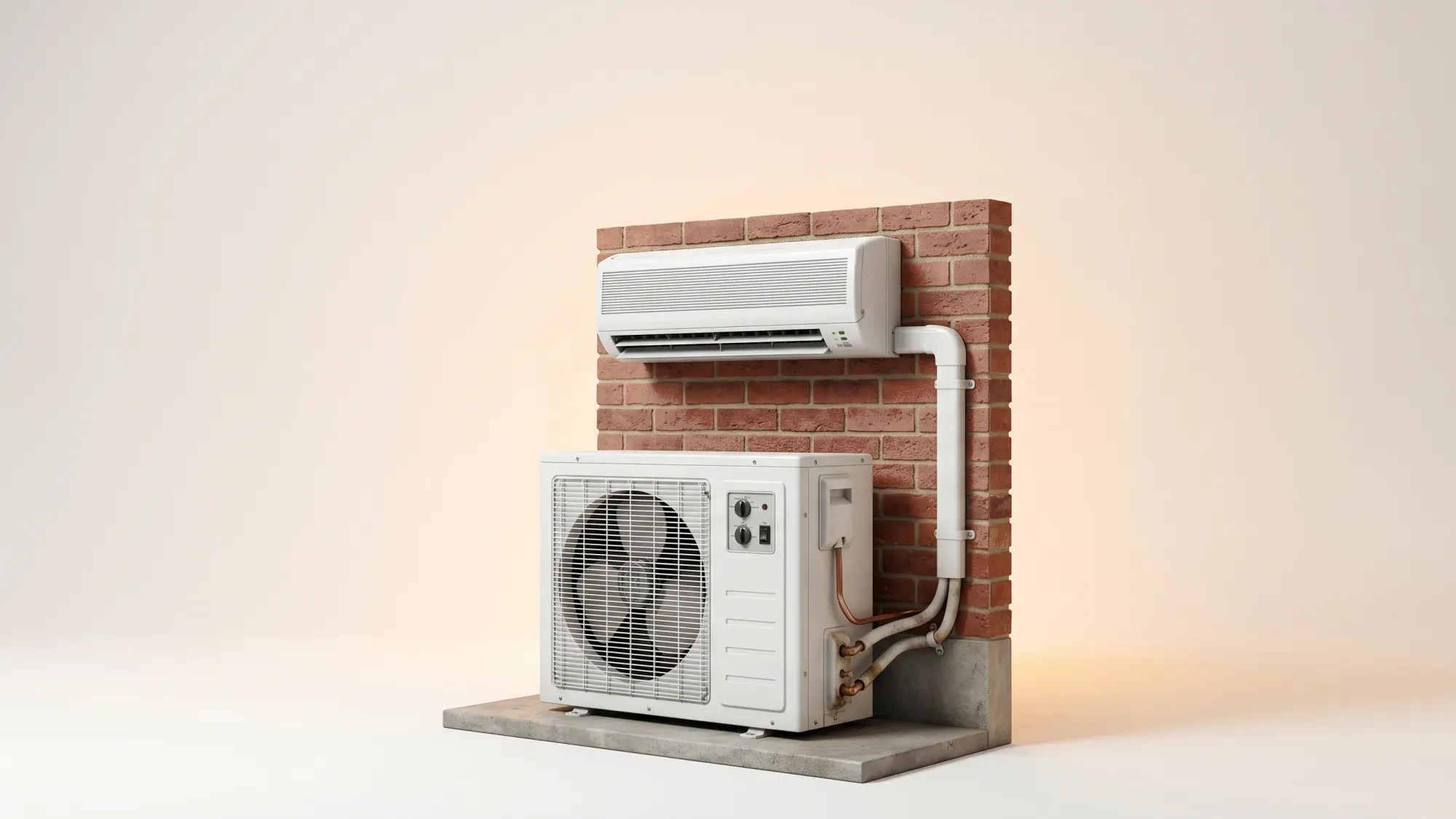
An air conditioner operates by circulating a refrigerant through a closed loop, absorbing heat from your indoor air and releasing it outdoors. The main components involved are the compressor, condenser, expansion valve, and evaporator. The compressor is the most energy-intensive part, responsible for pressurising the refrigerant. The more it works, the more electricity your unit consumes.
Kilowatt-hours (kWh) and your energy bill
Your electricity bill measures energy consumption in kilowatt-hours (kWh). One kWh is the amount of electrical energy consumed when a 1-kilowatt device runs for one hour. The running cost of an air conditioner is directly influenced by its power consumption in kilowatts (kW), the duration of use, and the prevailing electricity unit rate in pence per kilowatt-hour (p/kWh). For instance, the average electricity unit rate under the Ofgem Price Cap for 1 July to 30 September 2026 is 26.11p per kWh, inclusive of 5% VAT.
Several factors determine how much electricity your air conditioner uses and, consequently, how much it costs to run.
Unit power and efficiency ratings (EER, SEER, SCOP)
The power consumption of an AC unit, typically measured in watts or kilowatts, is a primary cost driver. Modern units come with efficiency ratings such as Energy Efficiency Ratio (EER), Seasonal EER (SEER), and Seasonal Coefficient of Performance (SCOP). Higher ratings indicate better efficiency, meaning the unit uses less electricity to provide the same cooling or heating output. Upgrading from a low-efficiency unit to a modern system can reduce energy consumption significantly.
Usage patterns and thermostat settings
How often and at what temperature you run your air conditioner significantly impacts its electricity consumption. Setting the thermostat significantly lower than necessary forces the unit to work harder and longer. Increasing your thermostat setting by just one degree Celsius can reduce your AC's energy consumption by around 1-3% for each 8-hour period.
Insulation, room size, and external temperature
The quality of your home's insulation, the size of the room being cooled, and the external temperature all play a role. Poor insulation and draughts allow heat to enter, making the AC unit work harder to maintain the desired temperature. Larger rooms naturally require more cooling capacity, and higher outdoor temperatures increase the workload on the unit.
Maintenance and unit age
Neglecting regular maintenance can reduce an AC unit's efficiency over time. Clogged filters and dirty coils hinder airflow and heat exchange, forcing the system to consume more electricity. Regular maintenance, such as cleaning filters, can improve an AC unit's efficiency by 5% to 15%. Older units may also be less efficient than newer models, even when well-maintained.
Understanding how to calculate your AC's running cost helps you budget and identify areas for savings.
Step-by-step cost calculation for your unit
To calculate the hourly running cost of your air conditioner:
- Find your unit's power consumption: This is usually listed in watts (W) or kilowatts (kW) on the unit's label or in its manual. If it is in watts, divide by 1,000 to get kilowatts (e.g., 1,500W = 1.5kW).
- Determine your electricity unit rate: This is the cost per kWh on your energy bill. The average electricity unit rate under the Ofgem Price Cap for 1 July to 30 September 2026 is 26.11p per kWh.
- Calculate hourly cost: Multiply your unit's power consumption (in kW) by your electricity unit rate (in p/kWh).
- Example: A 1.5 kW AC unit running at 26.11p/kWh costs 1.5 kW * 26.11 p/kWh = 39.17p per hour.
Estimating costs for portable air conditioners
Portable air conditioners typically consume between 0.8 kWh and 2.5 kWh per hour, depending on their cooling capacity. For example, a 9,000 BTU portable AC unit might use around 0.99 kWh, costing approximately 26p per hour at the 26.11p/kWh rate. This translates to about £2.06 per day if used for eight hours.
Understanding the impact on your monthly bill
Once you have the hourly cost, you can estimate daily and monthly expenses based on your usage. Running a 1.5 kW unit for 8 hours a day at 26.11p/kWh would cost approximately £3.13 per day (39.17p * 8 hours). Over a month (30 days), this adds up to around £93.90. The average UK home uses around 2,500 kWh of electricity per year, so adding significant AC usage can notably increase your overall consumption and bill.
Effective management of your air conditioner's electricity consumption involves optimising usage patterns and maintaining the system.
Optimising thermostat settings and usage schedules
Set your thermostat to the highest comfortable temperature. Even a small adjustment can lead to significant savings. Consider using timers or smart thermostats to schedule your AC to run only when needed, such as cooling your home before you arrive or turning off when you are away.
Improving home insulation and draught-proofing
Good insulation and sealing draughts prevent unwanted heat from entering your home, reducing the workload on your air conditioner. Check windows, doors, and vents for leaks and seal them effectively. This ensures the cool air stays in and warm air stays out, making your AC more efficient.
Regular maintenance for peak efficiency
Regular maintenance is key to keeping your AC running efficiently. Clean or replace air filters monthly during periods of heavy use. Schedule professional servicing annually to check refrigerant levels, clean coils, and inspect other components. This can improve efficiency by 5% to 15% and extend the unit's lifespan.
Smart home integration and energy management
Integrating your air conditioner with smart home systems can offer advanced control and optimisation. Smart thermostats learn your preferences and adjust settings automatically. Energy management systems can provide insights into your AC's consumption, helping you make informed decisions.
Fuse Energy empowers customers with unparalleled transparency and control over their air conditioner's electricity usage and costs through the Fuse app.
Transparent pricing and understanding your tariff
Fuse Energy provides clear, understandable electricity tariffs, allowing you to easily see how your air conditioner usage translates into costs. This transparent pricing helps you make informed decisions about your energy consumption without hidden fees or complex calculations.
Real-time usage data in the Fuse app
The Fuse app, integrated with smart meters, offers real-time, granular data on your air conditioner's electricity consumption. This empowers you to see your usage and costs directly, helping you identify patterns and understand the immediate impact of your AC settings on your energy consumption.
Making smarter energy choices
The data provided by the Fuse app empowers you to identify patterns and make informed decisions to optimise for comfort without unexpected costs. This aligns with the brand's vision of making energy abundant and giving customers the ability to use energy without constant "moral arithmetic." Fuse also offers 24/7 human customer support to assist with questions about energy usage data or optimising air conditioner settings.
Understanding your air conditioner's electricity cost is a step towards greater control over your home energy. Fuse Energy is committed to providing the tools and transparency you need to manage your energy usage effectively. With clear pricing, real-time data, and dedicated support, you can make informed choices that keep your home comfortable and your bills predictable. Click here to switch to Fuse Energy today and discover a smarter way to manage your energy. You can also learn more about our mission to build a future with abundant energy here.