How to make your AC cheaper to run
UK residents can enjoy comfortable indoor temperatures with air conditioning (AC) without incurring excessive electricity bills. This guide provides practical advice on how to reduce the expense of operating your AC, focusing on efficiency, maintenance, and the crucial role of your energy tariff.
Making your home comfortable shouldn't mean sacrificing your budget. Fuse Energy helps you understand and manage your energy use, giving you the power to play with your consumption and keep costs down. Click here to get started.
Enter your address to get a quote and see how much you could save
Understanding air conditioning running costs in the UK
The cost of running an air conditioning unit in the UK isn't fixed; it depends on several factors, from the unit's specifications to how you use it and the price you pay for electricity. Getting to grips with these elements is the first step towards making your AC more affordable.
What drives your AC bill
Your AC bill is primarily driven by how much electricity your unit consumes and its energy efficiency. The unit's Energy Efficiency Ratio (EER) or Seasonal EER (SEER) indicates how effectively it converts electricity into cooling. A higher rating means less electricity used for the same cooling output. User behaviour, such as how low you set the thermostat and for how long the unit runs, also significantly impacts the total cost. Finally, the per-unit cost of electricity, determined by your energy tariff, directly dictates the expense of every kilowatt-hour (kWh) your AC uses.
Typical costs for different AC units
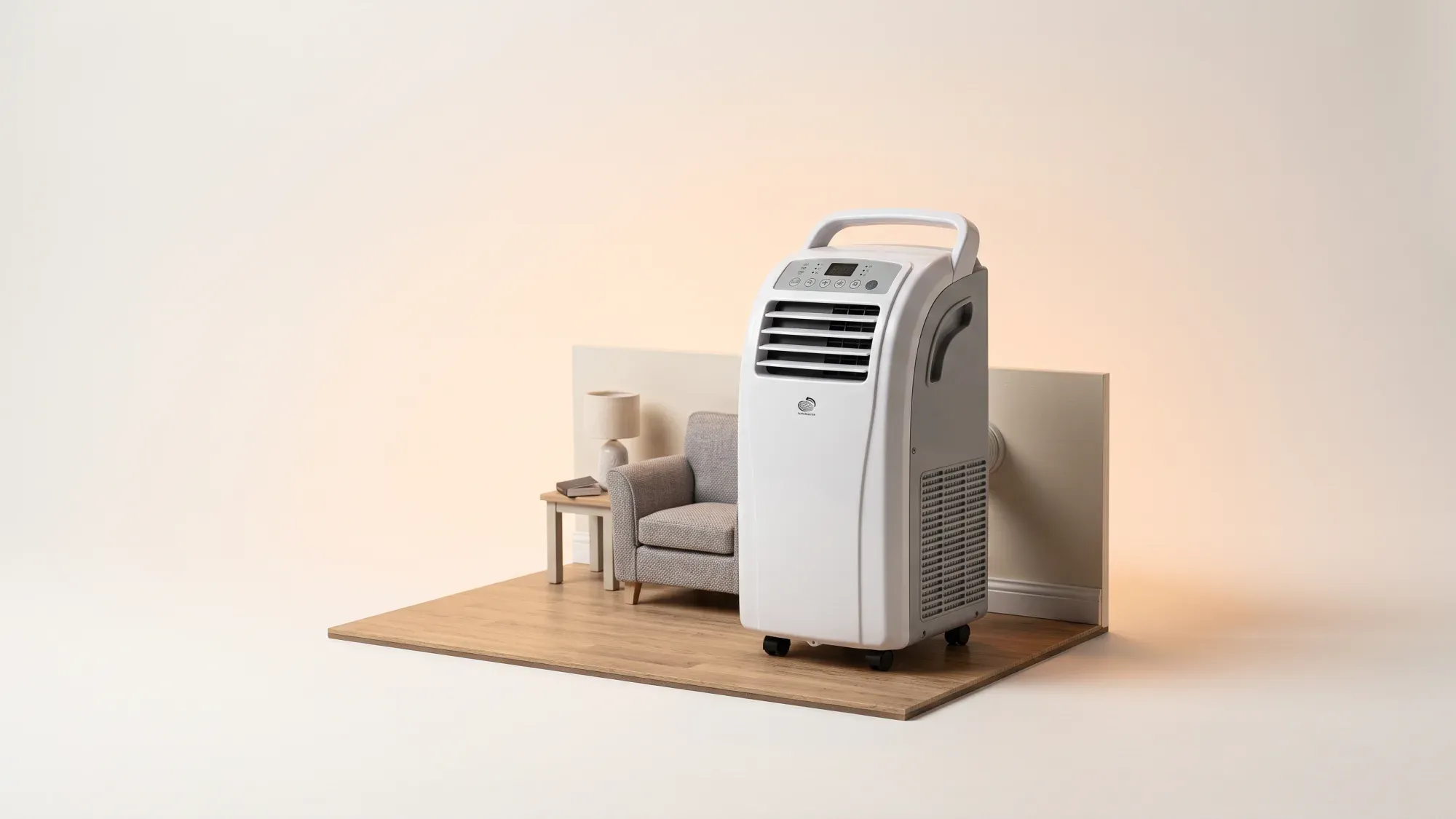
Running a typical portable air conditioning unit in the UK can cost between 20p and 60p per hour, depending on its power and your electricity tariff. For example, a 7,000 British Thermal Unit (BTU) portable AC unit typically consumes around 0.78 kWh per hour. A larger 9,000 BTU portable AC unit, on the other hand, typically consumes about 0.99 kWh per hour. These figures highlight that more powerful units, while cooling larger spaces more quickly, will generally cost more to run per hour.
Calculating your AC's hourly cost
To calculate your AC's hourly running cost, you need two pieces of information: your unit's power consumption in kilowatts (kW) and your electricity unit rate in pence per kilowatt-hour (p/kWh). The electricity unit rate for a typical Direct Debit household on the Ofgem price-cap default tariff from 1 July to 30 September 2026 is 26.11p per kWh1, inclusive of 5% VAT.
How do I calculate my AC's hourly running cost?
Multiply your AC unit's power consumption in kilowatts (kW) by your electricity unit rate in pence per kilowatt-hour (p/kWh). For instance, a hypothetical 1.3 kW unit running at 26.11p/kWh would cost approximately 34p per hour.
If your unit's power consumption is listed in watts (W), divide that number by 1,000 to get kilowatts. For example, a 1,300W unit is 1.3 kW. Then, multiply this kW figure by your electricity unit rate. Understanding what a kWh is can help you better track your usage.
Smart usage tips to reduce AC expenses
Making your air conditioning cheaper to run doesn't always mean buying a new unit. Often, it's about making smarter choices with the AC you already have. Simple adjustments to how you operate and maintain your unit can lead to noticeable savings.
Optimising thermostat settings
One of the most common pitfalls is setting the thermostat too low, which leads to overcooling and unnecessary energy consumption. Aim for a comfortable temperature that's not drastically different from the outside. Each degree lower than necessary can increase your energy usage. Consider using the "auto" setting for your fan, which allows the fan to switch off once the desired temperature is reached, rather than running continuously.
Effective maintenance for efficiency
Regular cleaning and maintenance are crucial for keeping your AC unit running efficiently. Neglecting these tasks can reduce your unit's effectiveness over time, forcing it to work harder and consume more electricity. This includes cleaning or replacing air filters monthly during periods of heavy use. Dirty filters restrict airflow, making the unit less efficient. Additionally, ensure the outdoor condenser coils are free from dirt and debris, as this can impede heat exchange.
Strategic use of timers and zones
Using timers allows you to program your AC to switch on and off at specific times, ensuring it only runs when you need it. For example, you can set it to cool your home before you arrive back from work and switch off shortly after you go to bed. If you have a multi-zone system, only cool the rooms you are currently using, rather than the entire house. For portable units, move them to the room you're occupying to concentrate cooling where it's needed most. These strategies are key to lowering your energy bills overall.
Home improvements for cooler, more efficient living
While optimising your AC usage is important, improving your home's ability to retain cool air can significantly reduce the demand on your air conditioning unit. These improvements can lead to a cooler home overall, even before you switch on the AC.
Improving insulation and draught-proofing
Operating AC in poorly insulated rooms or with windows and doors left open allows cool air to escape, wasting energy. Improving your home's insulation, particularly in the loft and walls, helps to keep the cool air in and the warm air out. Draught-proofing around windows and doors can also prevent cool air from leaking out, making your AC more effective and reducing its running time.
Shading and ventilation strategies
Strategic shading can prevent your home from overheating in the first place. Close curtains or blinds on south-facing windows during the hottest parts of the day to block direct sunlight. Consider external shading like awnings or planting deciduous trees that provide shade in summer but allow sunlight through in winter. In the evenings, when the outside temperature drops, open windows on opposite sides of your home to create a cross-breeze and naturally ventilate your living spaces.
The impact of appliance heat
Many household appliances generate heat, contributing to the overall temperature of your home and making your AC work harder. Things like ovens, tumble dryers, and even older light bulbs can raise indoor temperatures. Try to use these appliances during cooler parts of the day or when your AC isn't running. Switching to energy-efficient LED lighting can also help reduce ambient heat.
The role of your energy tariff in AC affordability
Even with the most efficient AC unit and smart usage habits, the price you pay for electricity remains a fundamental factor in your running costs. Your energy tariff directly influences how much each hour of air conditioning costs you.
How your electricity rate affects AC costs
The unit rate of electricity is the direct cost multiplier for every kilowatt-hour your AC consumes. The average UK home uses around 2,500 kWh of electricity per year. If your tariff has a higher unit rate, every hour your AC runs will be more expensive. Conversely, a lower unit rate means more affordable cooling. This is why choosing the right energy tariff is as important as optimising your unit's efficiency. For more details, you can learn about understanding your energy bill.
Choosing an energy supplier
Fuse Energy empowers UK residents to use their air conditioning comfortably and without guilt by combining smart usage and maintenance tips with a modern energy experience. Fuse's approach to energy encourages smart usage, making comfortable cooling more affordable. Instead of telling customers to 'use less' AC, Fuse encourages smart usage to enable comfortable cooling without excessive cost, aligning with our vision of abundant energy.
Monitoring your energy usage
Understanding your energy consumption is key to managing costs. Fuse's app provides clear energy usage data, helping customers monitor and understand their overall consumption to make informed decisions and manage costs effectively. This transparency allows you to see the direct impact of your usage habits and tariff choice on your bills, aligning with Fuse's vision of abundant energy for comfortable living. If you have a smart meter, you can get even more detailed insights.
Managing your energy bills should be clear and easy to understand. Fuse Energy focuses on straightforward pricing, so you can see exactly what you're paying without unnecessary complexity. If you have a smart meter, you can view detailed usage data through the app or website, helping you understand how you can lower your bills. Our 24/7 human support team is always on hand with fast response times whenever you need help. Click here to switch to Fuse Energy today. Find out about our mission by clicking here.
References
Disclaimer
For the avoidance of doubt, this article is provided for informational purposes only and is not intended to constitute legal or financial advice. The author and/or Fuse Energy shall not be responsible for any losses arising out of any reliance on the information contained herein.