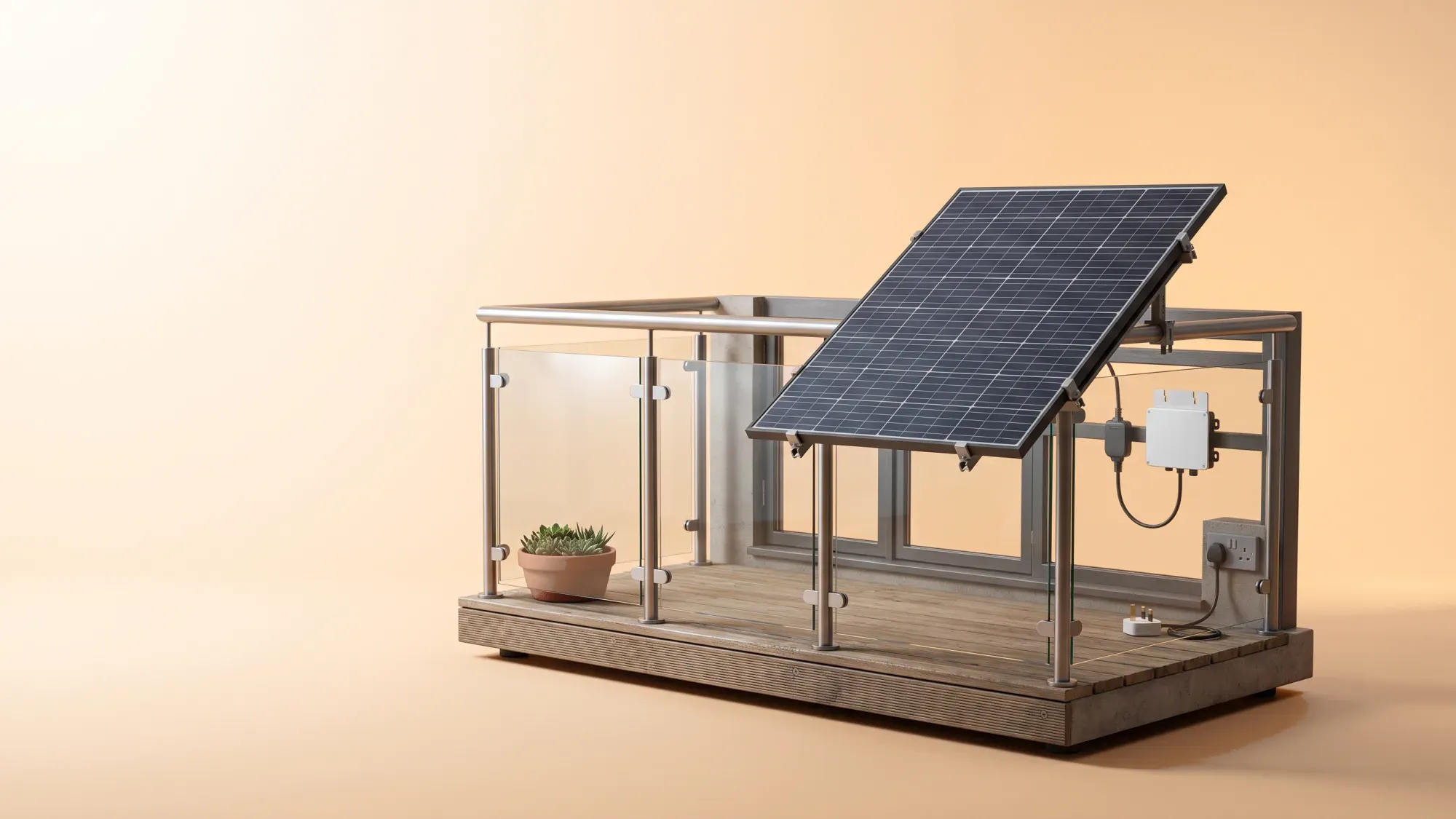
Plug-in solar systems are now legal across Great Britain, effective from 27 August 2026.1 This landmark change opens up a new way for households to generate their own clean electricity and reduce energy bills. These easy-to-install panels, often called balcony solar, can be plugged directly into homes, offering greater control over energy use for renters and apartment dwellers previously excluded from solar benefits. This legalisation marks a significant shift, empowering individuals to tap into renewable energy without the complexities of traditional rooftop installations.
The basics of balcony solar systems
Plug-in solar panels are compact, self-contained solar electricity generation systems designed for easy installation and direct connection to a standard electrical socket. Unlike larger rooftop solar arrays, these systems are typically much smaller, making them suitable for a wider range of properties, including flats and rented homes. They convert sunlight into electricity, which is then used by appliances within the home, reducing the amount of power drawn from the grid. These systems are often referred to as "balcony solar" due to their suitability for smaller outdoor spaces like balconies, patios, or garden sheds.
How plug-in solar generates electricity
A typical plug-in solar kit combines one or more compact photovoltaic (PV) panels with an inverter and a manufacturer-supplied power lead. The panels produce direct current (DC) electricity, which the inverter then converts into alternating current (AC) that can flow into your home's wiring. This AC electricity can then power your household appliances. If the panels generate more electricity than you are currently using, the excess is automatically exported to the grid. Conversely, if your home uses more electricity than the panels generate, the additional power is automatically drawn from the grid as normal.
Legalisation date: 27 August 2026
Plug-in solar systems became legal for purchase and use across Great Britain from 27 August 2026. This change removes a long-standing regulatory barrier that previously hindered their widespread adoption in the UK. The legalisation applies to England, Scotland, and Wales, with Northern Ireland expected to follow suit. The government announced this move to make plug-in solar available within months, and the market for these panels is now open to households, with products available in major UK retail stores.
Permitted development rules across the UK
The legal changes include updated permitted development rules, particularly in England, which mean that for most properties, planning permission is not required for small solar installations. However, conditions still apply regarding factors like roof and wall projection, and specific rules may differ for listed buildings or properties in conservation areas. Scotland and Wales have their own local planning requirements, while Northern Ireland's rules are distinct. Tenants and leaseholders should always obtain permission from their landlord, freeholder, or managing agent before installation. Owners in Great Britain are required to register their installations with their local Distribution Network Operator (DNO) through a short online process. A central registration website will be launched to facilitate this.
Safety and wiring compatibility
The legalisation of plug-in solar follows rigorous, independent safety testing covering the key electrical components of these systems. This testing confirmed that compliant panels are safe and compatible with UK wiring. The UK's safety specification is considered more stringent than that of Germany, where plug-in solar technology is already widely used.
Reducing your household electricity bills
Plug-in solar systems offer a tangible way to reduce household electricity bills. The UK government estimates that these systems could cut annual electricity bills by as much as £110 a year. This saving is based on an 800W system under favourable conditions, such as a south-facing panel with little shading, and a household that uses electricity during the day. While an 800W system won't halve your electricity bill, it can make a noticeable difference, especially for households with consistent daytime electricity demand. The average annual electricity bill in the UK is around £1,664 a year.
Clean energy access for renters and apartment dwellers
Previously, access to solar energy was largely limited to homeowners with suitable roofs for traditional installations. Plug-in solar changes this, making clean energy accessible to renters and apartment dwellers who may not have the option of rooftop solar. These systems provide an accessible, low-commitment entry point to renewables for thousands of households.
Contributing to energy independence
By generating a portion of your own electricity, plug-in solar systems contribute to greater energy independence for individual households. This move aligns with a broader shift towards homegrown, clean energy. UK’s Energy Secretary Miatta Fahnbulleh highlighted this benefit, stating, "From this summer, we’re giving more families the ability power their homes with clean homegrown energy".
Choosing the right 800W solar kit
When selecting a plug-in solar system, it is crucial to choose a kit that complies with the UK Interim Product Specification. These systems are capped at 800W of output. While some panels might be capable of producing more, the inverter will limit the output to stay within the legal 800W limit.
Self-installation and placement tips
One of the key advantages of plug-in solar is its ease of installation, often not requiring professional help. However, proper placement is vital to maximise energy generation. Panels should be installed in an optimal location to maximise sunlight exposure, ideally south-facing with a 30° tilt and minimal shading. Outdoor components and sockets need suitable weather protection, and the mounting system must be designed for wind, snow, and heat.
Understanding your system's output and savings
An 800W plug-in solar kit can generate a significant amount of electricity annually, depending on factors like usage, efficiency, location, orientation, and panel angle. The average UK home uses around 2,500 kWh of electricity per year. This means a plug-in system could cover a notable portion of your daily electricity needs, especially during daylight hours.
Monitoring your generation and consumption
To truly maximise the benefits of your plug-in solar system, understanding your energy generation and consumption patterns is key. Fuse Energy's app provides transparent pricing and real-time usage data, allowing you to see how much electricity your panels are generating and how much your home is consuming. This insight empowers you to adjust your usage to align with peak solar generation, optimising your savings.
Integrating plug-in solar with your home energy solution
While Fuse Energy does not sell or install plug-in solar panels, we support customers in integrating microgeneration into their home energy strategy. Our digital tools help you make the most of your self-generated electricity by providing intelligent consumption insights. This allows you to move beyond simply plugging in, towards a more active and informed management of your home's energy flow. Fuse's 24/7 human customer support is also available to assist you as you transition to more independent energy use.
Growth in microgeneration and green technology adoption
The legalisation of plug-in solar is a significant step in the growth of microgeneration and green technology adoption in Great Britain. It complements the existing increase in conventional solar and battery installations, with almost 150,000 certified solar panel installations in the first half of 2026 alone. This indicates a strong and growing demand for home renewable energy solutions.
Policy support and industry welcome
The renewable energy industry has widely welcomed the move. Chris Hewitt, CEO of Solar Energy UK, noted that "this will bring cheap, clean power to households that have not been able to access the benefits of solar and batteries". This policy change reflects a commitment to expanding access to clean energy and empowering more families to take control of their energy future.