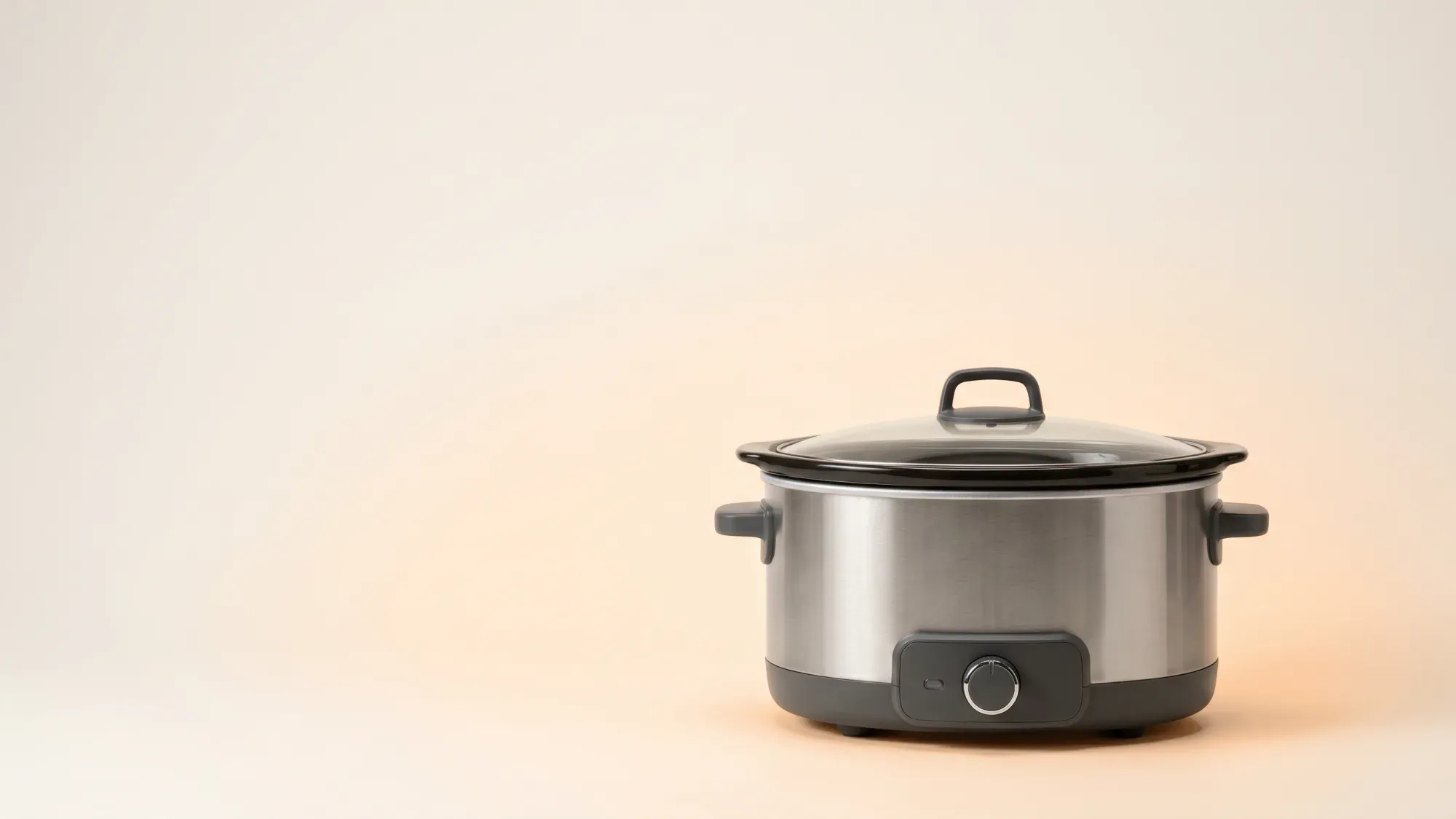
Understanding the electricity cost of household appliances is crucial for managing your budget effectively. For UK homes, a slow cooker can be a valuable tool for preparing meals, and knowing its energy consumption allows for informed decisions about its use. A typical 150W slow cooker costs approximately 3.92p per hour to run, based on the current Ofgem Price Cap electricity unit rate of 26.11p per kilowatt-hour (kWh). This article provides a transparent breakdown of slow cooker electricity costs, offering practical insights and efficiency tips to empower you in your energy choices.
Understanding your slow cooker's energy consumption can help you manage your household energy costs. Fuse Energy provides clear pricing and usage data to help you make informed choices about your energy use. Click here to switch to Fuse Energy today.
Slow cookers are designed for long, gentle cooking, making them ideal for stews, casseroles, and other dishes that benefit from extended heat.
How slow cookers work
A slow cooker operates by using a heating element to warm a ceramic or stoneware pot, which is then covered with a lid. The low, consistent heat allows food to cook slowly over several hours, tenderising ingredients and blending flavours. Unlike an oven, which heats a large cavity, a slow cooker concentrates heat efficiently within its smaller cooking vessel.
Key factors influencing electricity consumption
Several factors determine how much electricity your slow cooker uses:
- Wattage: This is the power rating of your appliance, usually found on the base or in the manual. Common wattages range from 100W to 300W. A higher wattage means more power consumption.
- Cooking duration: Slow cookers are designed for long cooking times, typically 4-8 hours. The longer it runs, the more electricity it uses.
- Setting (low/high): Most slow cookers have 'low' and 'high' settings. The 'high' setting uses more power to reach temperature faster, but once at temperature, the difference in continuous power draw between settings can be minimal.
- Food quantity: A fuller slow cooker might retain heat better, but it will also take longer to reach cooking temperature, potentially balancing out energy use.
To accurately calculate the cost of running your slow cooker, you need three pieces of information: its wattage, how long you use it, and your current electricity unit rate.
The formula
The basic formula to calculate electricity cost is:
(Wattage (W) / 1000) × Hours used (h) × Electricity unit rate (p/kWh) = Total cost (p)
Let's break this down with an example.
Example calculation
Assume you have a 150W slow cooker and your electricity unit rate is the Ofgem Price Cap of 26.11p per kWh, effective from 1 July to 30 September 2026.
-
Convert wattage to kilowatts (kW):
150W ÷ 1000 = 0.15 kW
-
Calculate cost per hour:
0.15 kW × 26.11 p/kWh = 3.9165p, which rounds to approximately 3.92p per hour.
-
Calculate cost for an 8-hour cooking cycle:
0.15 kW × 8 hours × 26.11 p/kWh = 31.332p, which rounds to approximately 31.33p.
So, running a 150W slow cooker for 8 hours costs approximately 31.33p.
Comparing costs: slow cooker vs oven
Slow cookers are generally more energy-efficient than traditional ovens for long cooking tasks. For comparison, a typical electric oven might use around 2,500W (2.5 kW).
Let's compare the 150W slow cooker with a hypothetical 2,500W (2.5 kW) oven, both running for 8 hours, using the same 26.11p/kWh electricity unit rate:
- Slow cooker (150W): 0.15 kW × 8 hours × 26.11 p/kWh = 31.33p
- Oven (2,500W): 2.5 kW × 8 hours × 26.11 p/kWh = 522.2p (£5.22)
This comparison clearly shows the significant energy savings a slow cooker can offer for dishes requiring extended cooking times.
Maximising your slow cooker's efficiency can lead to further savings on your electricity bill.
Choose the right size
A slow cooker that is too large for your typical meal will have more empty space, potentially leading to less efficient heating. Choose a size appropriate for your household's needs.
Don't peek
Lifting the lid releases heat and steam, extending cooking time and increasing energy consumption. Resist the urge to check on your food frequently.
Batch cook
Prepare larger quantities of food in one go. This allows you to cook multiple meals for the week, saving energy compared to cooking smaller portions daily.
Thaw frozen food first
Cooking frozen ingredients directly in a slow cooker requires more energy and time to bring them up to temperature. Thawing food beforehand can reduce cooking duration.
Utilise off-peak electricity
If you are on a time-of-use tariff (e.g., Economy 7 or a smart meter tariff with cheaper overnight rates), you might be able to start your slow cooker during off-peak hours to take advantage of lower electricity prices. Fuse Energy offers tariffs designed to help you make the most of cheaper energy periods.
Keep it clean
A clean slow cooker, especially the heating element and exterior, can operate more efficiently. Food residue can sometimes impact heat transfer.
Managing your energy bills should be clear and easy to understand. Fuse Energy focuses on straightforward pricing, so you can see exactly what you're paying without unnecessary complexity. If you have a smart meter, you can view detailed usage data through the app or website, helping you understand how you can lower your bills. Our 24/7 human support team is always on hand with fast response times whenever you need help. Click here to switch to Fuse Energy today. Find out about our mission by clicking here.