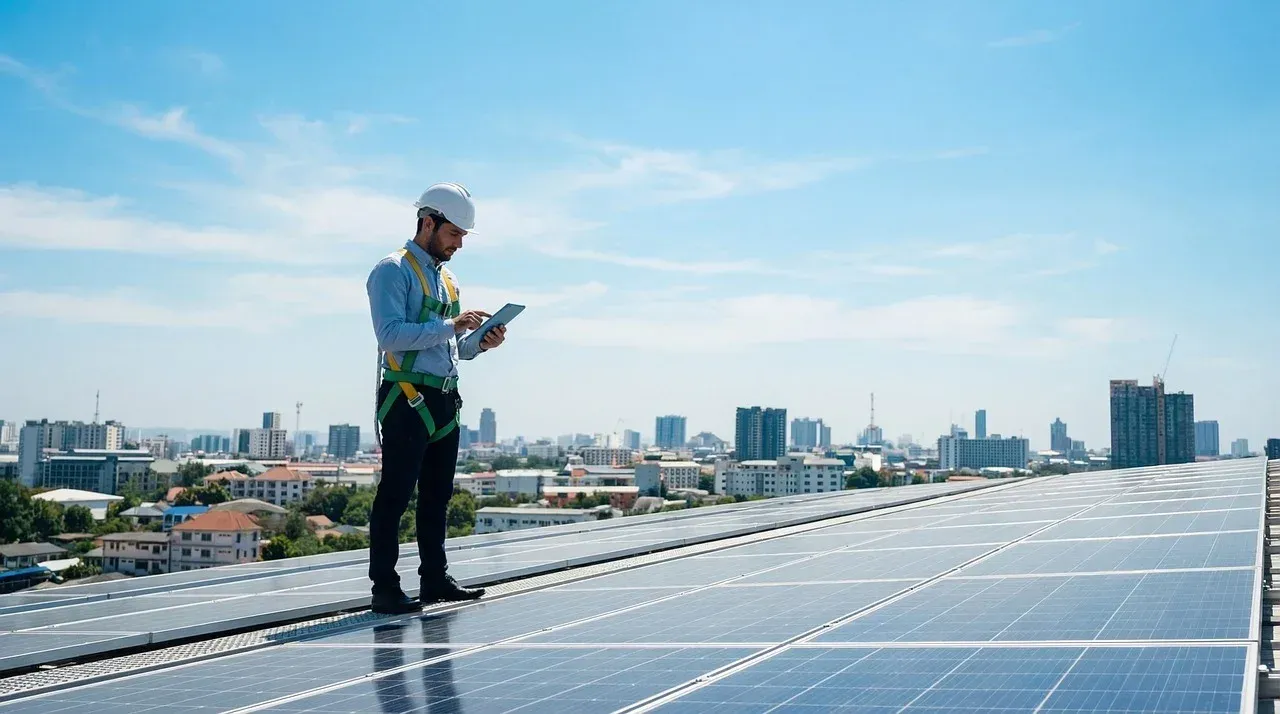
Choosing the right commercial solar installers is a pivotal decision for any UK business looking to harness the power of the sun. This guide will walk you through the essential steps, from understanding the benefits of solar power installation to navigating costs, regulations, and ultimately, optimising your solar investment. By selecting reputable solar panel installers, your business can achieve significant cost savings, enhance sustainability, and gain greater energy independence.
Managing your business's energy should be straightforward, whether you're considering solar or not. Fuse Energy offers clear pricing and tools to help you understand your consumption. Click here to see how Fuse Energy can simplify your business energy.
Why invest in commercial solar for your UK business?
Embracing commercial solar offers a multitude of advantages, transforming your operational costs and environmental footprint.
Key benefits: cost savings, sustainability, and energy independence
Installing solar panels on your business premises significantly reduces reliance on grid electricity, leading to substantial cost savings on your energy bills. Beyond the financial benefits, it demonstrates a strong commitment to sustainability, appealing to environmentally conscious customers and stakeholders. Generating your own power also provides a degree of energy independence, shielding your business from volatile energy prices and potential supply disruptions.
Understanding your return on investment (ROI) and payback period
A key consideration for any business solar project is its financial viability. Understanding your Return on Investment (ROI) and the payback period is crucial. Commercial solar panels in the UK often offer a compelling ROI of 14-20% or more, with typical payback periods ranging from 3 to 8 years. ROI measures the profitability of your solar investment over its lifetime, while the payback period indicates how long it will take for your initial investment to be recouped through energy savings and incentives. Reputable solar installers will provide detailed financial projections to help you make an informed decision.
How to choose a reputable commercial solar installer
The success of your commercial solar panel installation hinges on selecting the right partner. This involves careful vetting and asking the right questions.
The importance of MCS certification and accreditations for solar panel installers
When searching for solar installers, MCS Certification is non-negotiable. The Microgeneration Certification Scheme (MCS) is a UK-based quality assurance initiative that certifies products and installers in the renewable energy sector. It ensures that your solar panel installation meets high standards and is a prerequisite for accessing UK government incentives, such as the Smart Export Guarantee (SEG). Always check for other relevant accreditations and industry memberships.
Vetting installers: experience, references, and warranties
Beyond certifications, thorough vetting installers is essential. Look for companies with a proven track record in commercial solar panel installation, ideally with projects similar in scale to yours. Request references from previous business clients and inspect their work. Critically, understand the warranties offered on both the solar panels and the installation workmanship. A strong warranty provides peace of mind for your long-term solar investment.
Key questions to ask potential solar installers
Before committing, ask potential solar installers these questions:
Can you provide MCS certification details and proof of insurance?
What is your experience with commercial projects of our size and type?
What are the estimated solar panel installation costs and projected payback period?
What warranties do you offer on equipment and workmanship?
How do you handle planning permission and grid connection?
Navigating commercial solar costs, grants, and regulations
Understanding the financial and regulatory landscape is vital for any business looking to install solar panels.
Understanding solar panel installation costs for businesses
The solar panel installation costs for businesses vary widely based on system size, panel type, roof complexity, and location. As of 2024, the average price for commercial solar installations ranged between £1,000 to £1,500 per kilowatt peak (kWp). In 2026, businesses can expect to pay between £660 and £1,200 per kilowatt (kW) for a fully installed system. Factors like the quality of components, labour, and associated electrical work all contribute to the overall cost of installing solar panels. Obtaining detailed, transparent quotes from several companies that install solar is crucial for comparison.
UK government grants and incentives for solar power installation
The UK government offers various UK government grants and incentives for solar power installation to encourage businesses to adopt renewable energy. The Smart Export Guarantee (SEG) is a government-backed scheme that requires energy suppliers to pay businesses for excess electricity exported to the grid. Additionally, tax reliefs such as the Annual Investment Allowance (AIA) allow businesses to deduct 100% of qualifying capital investment, including solar panels, from taxable profits up to £1 million per year. Other schemes like the UK Shared Prosperity Fund (UKSPF) may also be available for small and medium-sized enterprises (SMEs).
Planning permission and grid connection for business solar projects
Large-scale business solar projects often require planning permission from your local council. However, many commercial rooftop solar installations fall under 'permitted development rights', meaning a full planning application may not be needed, provided specific conditions are met. Even with permitted development, notification to your local authority is typically required before work begins.
Furthermore, securing grid connection approval from your Distribution Network Operator (DNO) is a critical step to ensure your system can safely and legally connect to the national grid. For most commercial installations, this involves the G99 application process, which requires pre-application submission, technical review, and written approval from the DNO before commissioning. Your chosen solar installer should guide you through these complex regulatory processes.
The commercial solar installation process: from assessment to activation
A clear understanding of the commercial solar installation journey helps manage expectations and ensures a smooth project.
Initial site surveys and feasibility studies for installing solar panels
The process begins with initial site surveys and feasibility studies for installing solar panels. This involves assessing your energy consumption, roof or land suitability, shading issues, and structural integrity. These studies determine the optimal system design, estimated energy generation, and overall project viability.
Managing the installation and commissioning phases
Once plans are approved, the installation phase commences, followed by commissioning. Your solar panel installer will manage the procurement of equipment, the physical mounting of panels, electrical wiring, and inverter installation. Commissioning involves testing the system to ensure it operates safely and efficiently, ready for activation and connection to the grid.
Post-installation support and maintenance
After activation, reliable post-installation support and maintenance are key to maximising your system's lifespan and performance. This includes monitoring, cleaning, and addressing any technical issues. Discuss maintenance contracts and response times with your solar electricity installation provider.
Optimising your energy strategy with smart energy management
To truly maximise the benefits of your energy infrastructure, integrating it into a smart energy management strategy is essential.
Tracking energy consumption and its impact on your bills
Once your energy systems are live, tracking energy consumption is paramount. Understanding how much electricity and gas your business uses and its direct impact on your energy bills allows you to see real-time savings. This data helps you verify the performance of your energy systems and ensures you're getting the most out of your investment.
Leveraging data for financial insights and maximised savings
At Fuse Energy, we understand the importance of clear energy data. Our platform provides detailed insights into your electricity and gas consumption. You can leverage our data tools, such as get_charts_multiple for consumption data, to analyse your energy patterns, helping you make informed decisions about your energy usage. Post-installation, these tools can help verify actual savings and track the financial performance of your energy investments.
Integrating energy benefits into your business's energy strategy
Integrating energy benefits into your broader energy strategy means using the insights from your consumption data to make smarter decisions about energy usage, storage, and future investments. This holistic approach ensures your energy infrastructure is not just an asset, but a fully integrated, financially beneficial component of your business's operation.
Take the stress out of managing your business's energy. With Fuse Energy, you get clear pricing, real-time usage data, 24/7 human customer support, and a modern energy experience designed around you. Switching takes as little as 3 minutes, so you can take control of your bills from day one. Click here to switch to Fuse Energy today and start simplifying your energy management. Find out about our mission by clicking here.
For the avoidance of doubt, this article is provided for informational purposes only and is not intended to constitute legal or financial advice. The author and/or Fuse Energy shall not be responsible for any losses arising out of any reliance on the information contained herein.