Selling electricity back to the grid: price per kWh
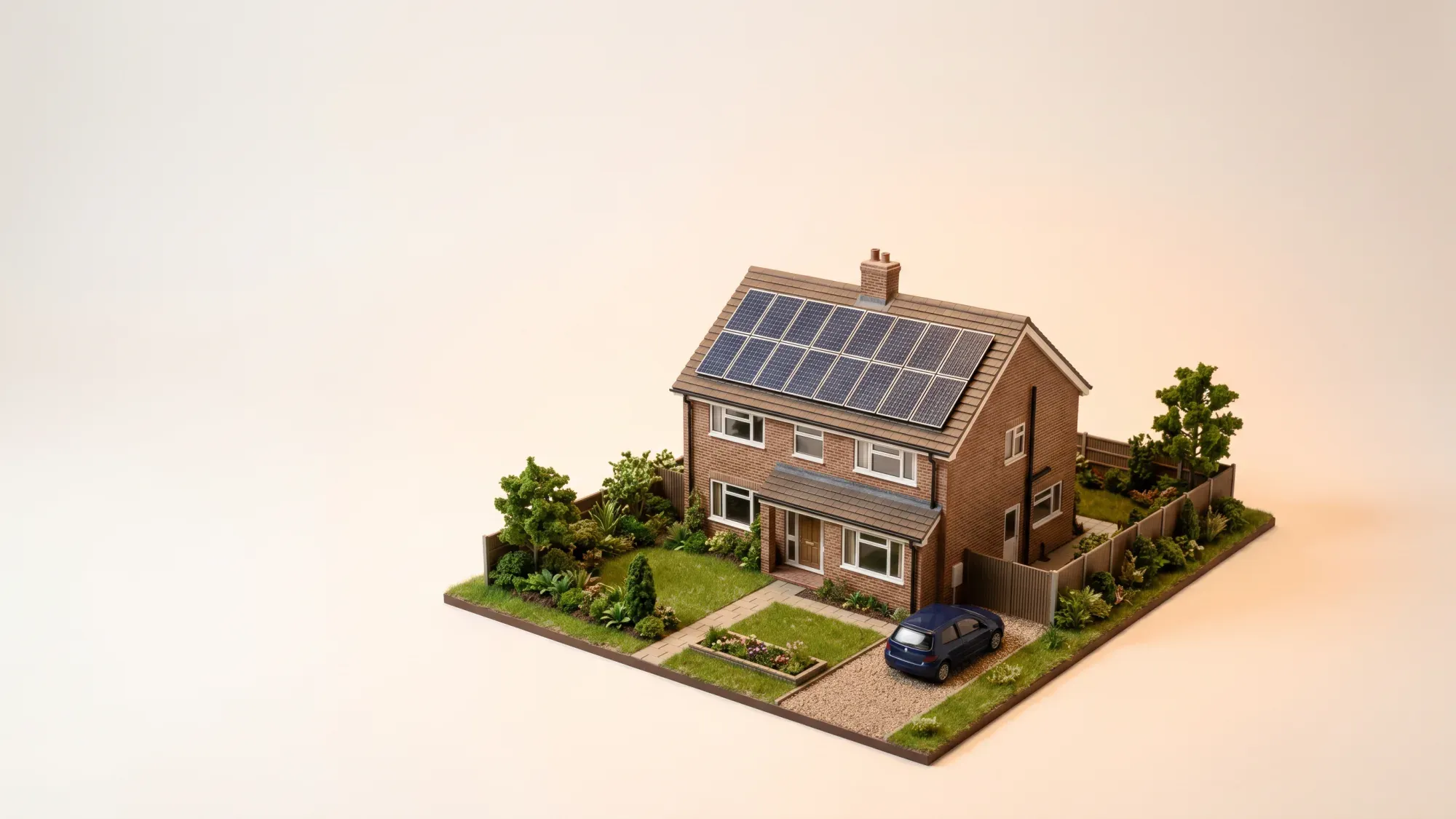
Homeowners with microgeneration systems in the UK can earn money by selling their surplus electricity back to the grid. This guide explains how to navigate the Smart Export Guarantee (SEG) scheme, what price you can expect per kilowatt-hour (kWh), and how to optimise your earnings.
Generating your own electricity, typically through solar panels, means you might produce more than you use. Instead of letting this surplus go to waste, you can export it to the National Grid and get paid for it. Fuse Energy empowers homeowners to understand and maximise their earnings through transparent tariffs and digital tracking.
Thinking about Selling electricity back to the grid? With Fuse Energy, you get clear pricing, real-time usage data, 24/7 human customer support, and a modern energy experience designed around you. Signing up takes just a few minutes, so you can take control of your bills from day one. Click here to switch to Fuse Energy today and start saving.
Enter your address to get a quote and see how much you could save
Understanding the Smart Export Guarantee (SEG)
What is the SEG?
The SEG is a government-backed initiative that mandates licensed electricity suppliers to pay homeowners for the renewable electricity they export to the grid. Introduced on 1 January 2020, the SEG replaced the Feed-in Tariff (FiT) scheme for new applicants. It aims to encourage the uptake of domestic green energy solutions by providing a financial incentive for small-scale low-carbon generation.
What is the SEG?
The SEG is a UK government scheme launched in January 2020 that requires licensed electricity suppliers to pay homeowners for surplus renewable electricity exported to the National Grid. It encourages the adoption of microgeneration technologies like solar panels by offering tariffs for this exported energy.
How does the SEG work?
Under the SEG, licensed electricity suppliers with over 250,000 domestic customers are legally required to offer at least one SEG tariff. Smaller suppliers can choose to offer tariffs voluntarily. These tariffs pay you for every kWh of electricity your system exports, measured by an export-capable smart meter. The rates, contract lengths, and payment terms are set by individual suppliers, meaning they can vary significantly.
Key benefits of selling surplus electricity
The primary benefit is earning money from electricity you do not use, effectively reducing your energy bills and potentially creating a new income stream. This also supports the UK's transition to a greener, more decentralised energy system by increasing the amount of renewable energy on the grid. For homeowners, it means greater control over their energy usage and a tangible return on investment for their microgeneration system.
Eligibility and requirements for SEG
To qualify for SEG payments, your microgeneration system and installation must meet specific criteria.
Microgeneration Certification Scheme (MCS)
A crucial requirement for most SEG tariffs is that your microgeneration system must be certified under the Microgeneration Certification Scheme (MCS) or an equivalent scheme. This certification ensures that both your renewable energy technology (such as solar panels) and its installation meet rigorous safety and performance standards. Without MCS certification, many suppliers will not offer you an SEG tariff.
Export-capable smart meter
You need a smart meter capable of providing half-hourly export readings to participate in the SEG scheme. This allows your supplier to accurately measure how much electricity you are sending back to the grid and calculate your payments. If you do not already have one, your energy supplier can often arrange for a free smart meter installation.
System size and type
The SEG covers various low-carbon technologies, including solar photovoltaic (PV) panels, wind turbines, hydropower, anaerobic digestion, and micro combined heat and power (CHP) systems. For most technologies, the total installed capacity must be up to 5 megawatts (MW), while for micro-CHP, it is typically limited to 50 kilowatts (kW).
Comparing Smart Export Guarantee tariffs
SEG rates are not universal; they vary between suppliers, making it essential to compare options.
Factors affecting SEG rates
SEG rates can differ based on several factors:
- Supplier: Each licensed supplier sets its own rates, which must be above zero.
- Tariff type: Some tariffs offer a fixed rate per kWh, while others are variable, meaning the price can fluctuate. Time-of-use tariffs might offer higher rates during peak demand periods.
- Import customer status: Many suppliers offer better SEG rates if you also purchase your import electricity from them.
- Battery storage: Some premium tariffs offer higher rates for customers with battery storage.
Finding the best SEG tariff
As of late 2026, SEG rates in the UK typically range from 1.5p to 15p per kWh, with some competitive tariffs offering around 13p per kWh for MCS-certified installations. However, some suppliers offer rates as high as 20p or even 29.4p per kWh under specific conditions, such as having a battery or being an import customer. It is crucial to shop around and compare different offers, considering not just the export rate but also any associated terms and conditions. Websites like Uswitch and Which.co.UK often provide comparison tables of current SEG rates.
Typical payment structures
Payments for exported electricity are usually made monthly or quarterly, depending on the supplier and tariff. Some suppliers might credit your earnings directly to your energy bill, reducing your overall costs. However, Fuse Energy's export payments are separate and paid out directly, not credited to your import bill. Fuse's digital-first approach and app can provide clear tracking of exported electricity and earnings, making it easy to see your benefits.
Maximising your export earnings
Beyond choosing a good tariff, there are strategies to get the most out of your microgeneration system.
Optimising self-consumption
The electricity you use directly from your own generation is often more valuable than the amount you get paid for exporting it. This is because the import price per kWh is typically higher than the export price. By optimising your self-consumption - for example, by running appliances like washing machines or dishwashers during daylight hours when your solar panels are generating - you reduce the amount of electricity you need to buy from the grid.
Tracking your exported electricity
Keeping track of your exported electricity and earnings is key to understanding your system's performance and ensuring you are getting paid correctly. Digital tools and apps provided by your energy supplier can offer real-time data on your generation, consumption, and export. Fuse's app, for instance, can provide transparent tracking of your exported electricity and earnings.
Future-proofing your system
Consider adding battery storage to your system. A battery allows you to store surplus electricity generated during the day and use it later, for example, in the evening when grid electricity is more expensive. This further reduces your reliance on grid imports and can increase the overall financial benefit of your microgeneration system.
Applying for an SEG tariff
The application process for an SEG tariff is generally straightforward, but requires specific documentation.
Step-by-step application process
- Ensure eligibility: Verify your system is MCS-certified and you have an export-capable smart meter.
- Research tariffs: Compare SEG tariffs from different licensed suppliers to find the best fit for your needs.
- Gather documentation: Collect necessary documents, including your MCS certificate, proof of ownership, and details of your smart meter.
- Apply to supplier: Submit your application to your chosen SEG licensee. This can often be done online.
- Receive payments: Once approved, you will start receiving payments for your exported electricity according to your tariff's terms.
If you do not have an export Meter Point Administration Number (MPAN), Fuse can help generate one. You will need to provide your DNO connection approval (G98/G99 paperwork) and an MCS certificate. Fuse will then forward these to the relevant Distribution Network Operator (DNO) to create a non-energised export MPAN. However, Fuse cannot energise this MPAN directly. You must first switch in with another supplier for export to energise it, and then you can switch to Fuse. Fuse offers in-app chat support, which can assist with SEG queries and the application process, simplifying the experience for homeowners.
Required documentation
Typically, you will need:
- Your MCS certificate (or equivalent) for your microgeneration system.
- Proof of ownership of the generation unit.
- Details of your export-capable smart meter, including its MPAN.
- Confirmation that you are not receiving export payments under the Feed-in Tariff scheme for the same electricity.
Switching SEG providers
You can switch SEG providers if you find a better tariff elsewhere. However, you cannot be on both a FiT and an SEG at the same time, or have SEGs from more than one supplier for the same electricity. If you are currently on a FiT, you would need to opt out of its export payments to join an SEG tariff.
SEG vs Feed-in Tariff (FIT)
Understanding the differences between these two schemes is important, especially if you have an older microgeneration system.
The end of FIT
The Feed-in Tariff (FiT) scheme closed to new applicants on 31 March 2019. It was designed to promote renewable energy by paying participants for both the electricity they generated and the surplus they exported to the grid. Payments under FiT were typically guaranteed for 20 or 25 years.
Key differences and similarities
The main difference is that FiT paid for both generation and export, while SEG only pays for exported electricity. FiT rates were generally fixed and guaranteed for a long period, whereas SEG tariffs are set by individual suppliers and can be variable. Both schemes aim to encourage renewable energy adoption and require eligible low-carbon technology.
What if I am on FIT?
If you are already receiving FiT payments, you will continue to do so for the duration of your contract (typically 20-25 years). You can choose to remain on your FiT, or you can switch the export element of your FiT to an SEG tariff. However, you cannot receive both FiT export payments and SEG payments simultaneously. It is worth comparing your current FiT export rate with available SEG tariffs, as SEG rates can sometimes be higher, but bear in mind that FiT payments are often inflation-linked and guaranteed for a longer term. According to Ofgem's medium Typical Domestic Consumption Value (TDCV) for electricity, effective from 1 July 2026, the average UK home uses around 2,500 kWh of electricity per year1.
Maximising your export earnings from microgeneration systems can significantly reduce your energy bills and contribute to a greener future. Fuse Energy offers transparent tariffs and in-app tracking to help you make the most of your exported electricity. Switching to Fuse is designed to be straightforward, allowing you to manage your energy effectively. Click here to switch to Fuse Energy today and explore how you can benefit.
References
Disclaimer
For the avoidance of doubt, this article is provided for informational purposes only and is not intended to constitute legal or financial advice. The author and/or Fuse Energy shall not be responsible for any losses arising out of any reliance on the information contained herein.