Plug-in solar legislation: what changes on 27 August 2026
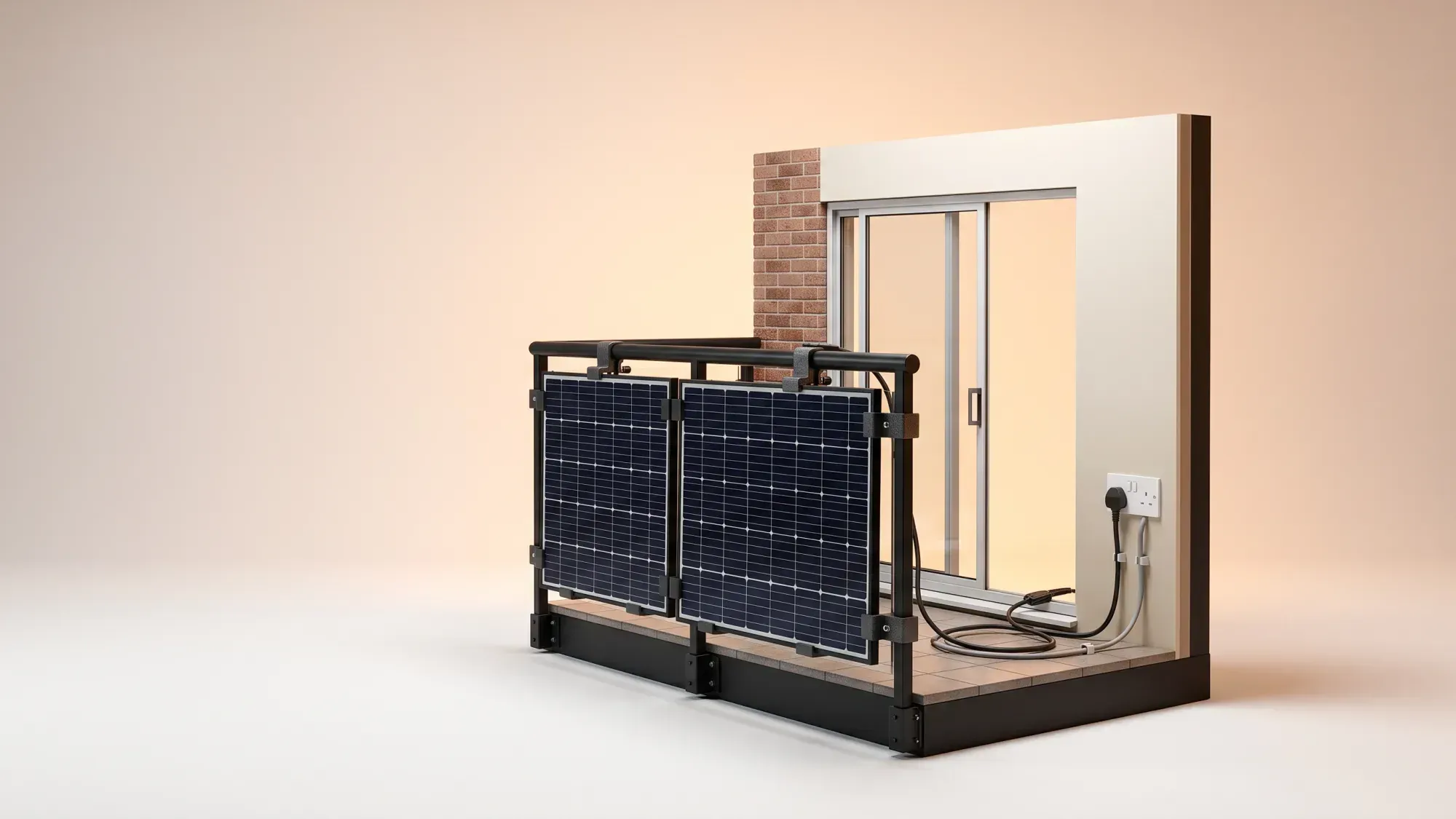
For years, millions of people across Europe have been quietly plugging compact solar panels into a standard socket and watching their electricity bills shrink. In Germany alone, over 1.5 million1 households had set up these so-called "balcony solar" systems by mid-2025. In the UK, the same approach sat in a frustrating legal grey area - technically possible, but officially unsanctioned.
That changes on 27 August 2026, the day plug-in solar becomes legal in the UK.
The government announced its intention in April 2026, and the law itself has now been made. SI 2026/848 was signed on 16 July 2026, laid before Parliament the next day, and comes into force on 27 August 2026. From that date, connecting a compliant solar generator through a standard wall socket stops being something the rules quietly forbid and becomes something the law explicitly provides for. If you've been curious about solar but put off by the cost of a full rooftop installation, or if you rent and assumed solar was simply not an option for you, this is the moment to pay attention.
Here's what the new law actually does, what the rules allow, and what it means in practice for your household.
Fuse Energy does not supply or install plug-in solar kits. What we do install is full home solar, end-to-end, with MCS and TrustMark certification covering planning approvals, paperwork, installation, and final checks. Tap the quote button below to get a tailored solar quote.
What is plug-in solar and why was it complicated before?
Plug-in solar (sometimes called balcony solar, portable solar, or a "solar balcony kit") is exactly what it sounds like: one or two solar panels - often mounted on a balcony rail, garden fence, or south-facing wall - connected to a small inverter that feeds electricity directly into your home through a standard plug socket.
The appeal is obvious. There's no scaffolding, no planning permission, and no expensive installation. You buy the kit, set it up, and it quietly generates electricity during daylight hours that offsets what you'd otherwise pull from the grid.
The catch, until recently, was that the UK's wiring regulations didn't formally account for this setup. That left consumers in an awkward position: the technology worked, but connecting it via a standard socket wasn't explicitly covered by the official rules electricians and insurers rely on. Many people simply didn't know whether they were allowed to do it.
What changes on 27 August 2026
BS 7671 is the document that sets the technical rules for electrical installations in the UK2. It was written around fixed installations wired in by a qualified electrician, which is precisely why a panel plugged into a ring socket could never comply with it, however well built the kit was. SI 2026/848 gets around that rather than rewriting it3. It amends the Plugs and Sockets etc. (Safety) Regulations 1994 so a standard BS 1363 plug can lawfully be supplied with a microgenerator, and it amends the Electricity Safety, Quality and Continuity Regulations 2002 so that a plug-in microgenerator complies with the government's Plug-in Solar Device Interim Product Specification instead of with BS 7671. That swap is the whole legal unblocking, in one sentence.
What counts as compliant is drawn tightly:
- The microinverter is capped at 800W AC output, with up to 2000W DC of panels behind it.
- The plug supplied with the kit must conform to BS 1363-1 and go straight into a fixed BS 1363-2 socket, never an extension lead or an adaptor.
- The kit must meet the Plug-in Solar Device Interim Product Specification (version 2, published 16 July 2026) and be installed to the manufacturer's instructions.
- Only complete products approved and listed on the ENA G98 Type Test Register can lawfully be self-connected.
One limit is worth flagging now, because it comes up constantly: the specification covers plug-in solar only. Plug-in batteries, and solar-plus-battery kits sold as one box, were deliberately left outside it, so socket-connected storage stays off limits for the time being.
In plain terms: from 27 August 2026 plug-in solar is a recognised, legitimate way to generate electricity at home. The regulations have caught up with the technology. The catch is that approval is product-specific, so it is the individual kit that has to qualify, not the idea.
Why the UK government moved now
The timing of this decision was not accidental. The UK's decision to fast-track plug-in solar stemmed from a convergence of pressures that made the status quo increasingly untenable.
The most immediate catalyst was energy security. Ongoing conflict in the Middle East and the fuel price volatility that followed made the UK's dependence on fossil fuel markets impossible to ignore. On 24 March 2026, the Department for Energy Security and Net Zero announced plug-in solar would be in shops "within months," explicitly framing the move as part of its response to the crisis. Energy Secretary Ed Miliband put it plainly: "The Iran War has once again shown our drive for clean power is essential for our energy security so we can escape the grip of fossil fuel markets we don't control."
Behind that immediate trigger sat longer-term structural pressure. The UK has a target of 45GW of solar capacity by 2030, more than double the current installed base, requiring solar to grow at every level, including the household. Yet the UK was an outlier in Europe: Germany alone registered over 426,000 new plug-in solar systems in 20251. British households facing rising bills had no equivalent option. Alongside the regulatory changes, the government committed £25 million to pilot plug-in kits specifically in low-income households, a signal that access (not just volume) was part of the policy intent.
What it means for UK households
The new rules open up solar to a far wider range of people than before and the benefits are real whether you own your home or rent it.
For renters, this is arguably the biggest shift the legislation brings. Traditional rooftop solar effectively required ownership: a permanent installation, full landlord consent, and a project that stays behind when you move. Plug-in solar changes that entirely. The panels are portable, leave no permanent marks, and connect through a standard socket. Under the Renters' Rights Act 2025, tenants can now formally request permission to install a plug-in solar system, and landlords cannot unreasonably refuse. That puts the burden on landlords to justify a refusal rather than on tenants to plead their case.
For homeowners, the appeal is simpler: meaningful savings without the complexity of a full rooftop project. A typical 800W system facing roughly south generates 700-900 kWh per year. The savings you capture depend on how much of that you use at home during daylight hours: electricity you generate and consume directly replaces grid electricity at your unit rate. At current rates, most households can expect to save £130-£200 per year from self-consumption alone.
It's worth knowing that plug-in solar doesn't currently qualify for Smart Export Guarantee (SEG) payments, the scheme that pays you for surplus electricity exported to the grid, because a DIY install can't be MCS-certified. That's expected to change around 2027, but for now the savings come entirely from what you use, not what you sell back.
Frequently asked questions
When can I buy plug-in solar?
Kits are already on sale, but the self-install route opens on 27 August 2026, when SI 2026/848 comes into force. Two things govern the timing. Only complete products approved against the Interim Product Specification and listed on the ENA G98 Type Test Register can lawfully be plugged in, and that register is still filling up, so it is worth holding out for kit that is actually on it. You will also need to submit a G98 notification to your Distribution Network Operator within 28 days of connecting, which is a short online form rather than an approval process. In the meantime, a number of companies are already offering plug-in solar with professional installation, so you don't have to wait if you want to get started sooner.
Is plug-in solar safe?
Yes, when you use a properly certified product and follow the installation guidelines. The 800W output cap in the new rules is specifically designed to keep the load within what standard UK household wiring can handle safely. The inverter in a compliant kit includes anti-islanding protection, which automatically shuts the system down if there's a problem with the grid supply, a key safety feature that prevents electricity feeding back into the network unexpectedly. Look for kits carrying UKCA or CE marking, and check before you buy that the product meets the Plug-in Solar Device Interim Product Specification and appears on the ENA G98 Type Test Register. As with any electrical product, buying from a reputable supplier and following the installation instructions makes a significant difference.
Can I install plug-in solar if I rent?
Yes - and this is one of the most significant parts of the 2026 rule change. Under the Renters' Rights Act 2025, you can formally request permission from your landlord to install a plug-in solar system, and they cannot unreasonably refuse. Because the kit is portable and leaves no permanent marks, it's a much easier conversation than asking to make structural changes to a property.
How long do plug-in solar panels last?
Most quality solar panels carry a 25-year performance warranty and will continue generating electricity beyond that, though output degrades slightly over time (typically around 0.5% per year). Inverters (the component that converts solar power into usable electricity) have a shorter lifespan of around 10-15 years and may need replacing once during the panel's lifetime.
Will plug-in solar affect my home insurance?
It can do, so it's worth letting your insurer know. Most standard home insurance policies will cover plug-in solar as contents once you've notified your insurer, though a small number may charge an additional premium. If you're renting, check whether your contents policy needs updating. It's a quick call and well worth making before you install.
What about plug-in batteries?
The new rules cover plug-in solar only. The Interim Product Specification explicitly excludes plug-in battery systems, solar-plus-battery kits sold as a single box, building-integrated PV, and PV installed to BS 7671 Section 712. The government acknowledged strong interest in battery-integrated products and deliberately kept them out to keep this route narrow and safety-led, so socket-connected storage stays a separate conversation for a later date.
Ready to look at full home solar instead? Tap the quote button below to get a tailored solar quote.
References
- The Guardian. If a million Germans have them, there must be something in it: how balcony solar is taking off
- UK Government. Plug-in solar consultation
- UK Government. The Plugs and Sockets etc. (Safety) Regulations 1994 and Electricity Safety, Quality and Continuity Regulations 2002 (Amendment) Regulations 2026
Disclaimer
For the avoidance of doubt, this article is provided for informational purposes only and is not intended to constitute legal or financial advice. The author and/or Fuse Energy shall not be responsible for any losses arising out of any reliance on the information contained herein.