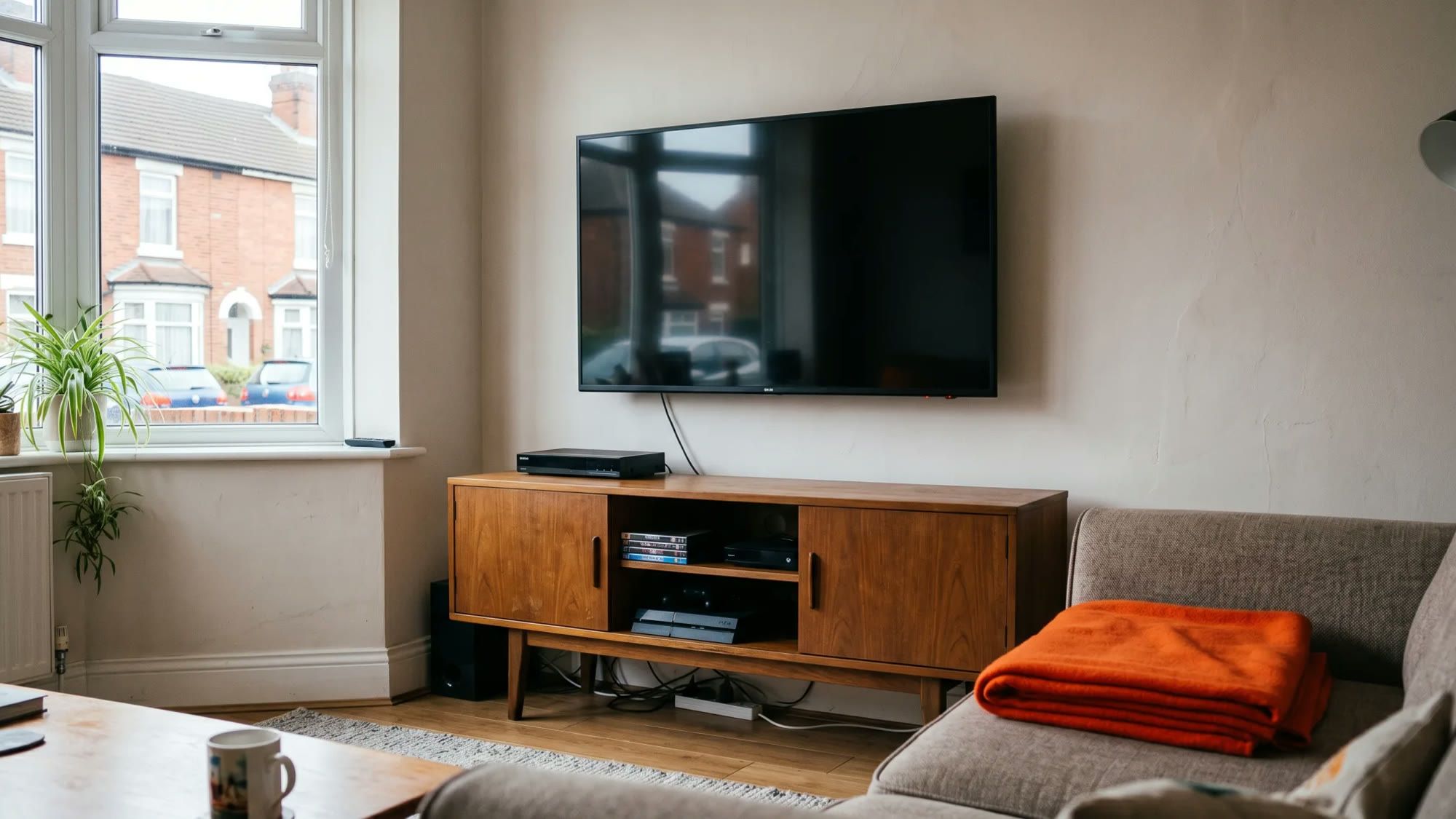
Understanding your TV's energy consumption is a smart move for managing household bills, especially with rising electricity costs. This guide clarifies how much power your TV uses, the factors that influence it, and practical steps you can take to reduce its running costs without compromising your viewing experience.
Understanding how much electricity your TV uses is key to managing your energy bills. With Fuse Energy, you can take control of your household energy consumption with clear pricing and real-time usage data. Click here to switch to Fuse Energy today.
Knowing how much electricity your television consumes is the first step towards smarter energy management. It is not just about the hours you spend watching; the type of TV, its size, and even its settings all play a significant role.
What are TV wattage and kilowatt-hours?
Wattage (W) measures the instantaneous electrical power an appliance uses. Your electricity bill, however, is based on kilowatt-hours (kWh), which represents the amount of energy consumed over time. One kWh is the amount of energy it takes to run a 1,000-watt appliance for one hour. A TV's wattage can usually be found on a label on the back or bottom of the set, or in the manufacturer's manual. For more details on this unit of measurement, you can read our guide on what is a kWh.
How TV technology affects power usage
The technology behind your TV significantly impacts its power consumption. Older models, particularly plasma TVs, were known for high energy use, often consuming several hundred watts. Modern TVs, such as LED and OLED, are generally more energy-efficient. LED (Light Emitting Diode) TVs are currently among the most efficient, typically using between 30 to 150 watts depending on size and settings. OLED (Organic Light Emitting Diode) TVs, while offering superior picture quality, generally use more electricity than LED TVs of the same size, especially when displaying bright scenes.
Several factors determine how much electricity your TV consumes. Being aware of these can help you make informed choices about your viewing habits and settings.
Screen size and resolution
Larger TVs require more power to illuminate their screens. For example, a 32-inch LED TV might use around 30-50 watts, while a 55-inch model could be closer to 60-100 watts. Higher resolutions, such as 4K or 8K, also increase energy demand because they involve lighting millions more pixels to create a sharper image.
Display technology: LED, OLED, and plasma
As mentioned, LED TVs are typically the most energy-efficient. OLED TVs, while popular for their vibrant colours and deep blacks, can consume more power, particularly when displaying bright content. Older plasma TVs are significantly less efficient than both LED and OLED models.
Brightness settings and picture modes
The brighter your TV screen, the more electricity it uses. Many TVs come with various picture modes (e.g., 'Vivid', 'Standard', 'Eco') that pre-set brightness and other display characteristics. 'Vivid' modes often use more power, while 'Eco' modes are designed to reduce consumption. Adjusting brightness manually or using energy-Saving modes can lead to noticeable reductions in electricity use.
Standby power consumption
Even when turned off, most TVs consume a small amount of electricity in standby mode to enable features like quick start-up, network connectivity, or software updates. Most modern TVs consume between 0.3 to 1 watt in standby mode. While this seems minimal, it can add up over time, contributing to what is known as "phantom load".
Understanding your TV's wattage and converting it into kilowatt-hours (kWh) allows you to calculate its actual running cost.
Finding your TV's wattage
The easiest way to find your TV's wattage is to check the label on the back or bottom of the unit, or consult the manufacturer's manual. This figure often represents the maximum power consumption. For a more accurate real-world measurement, you can use a plug-in watt meter to see how much power your TV uses during typical viewing.
Converting watts to kilowatt-hours (kWh)
To convert watts to kWh, divide the wattage by 1,000 to get kilowatts (kW), then multiply by the number of hours the TV is used.
Formula: (Wattage / 1,000) × Hours Used = kWh
For example, a 100-watt TV watched for 4 hours would consume (100 / 1,000) × 4 = 0.4 kWh.
Estimating daily, monthly, and annual costs
Once you have the kWh consumption, multiply it by your electricity unit rate to find the cost. As of July 2026, the average UK electricity unit rate for households on standard variable tariffs is 26.11p per kWh, though this can vary by region and payment method. For our calculations, we will use this rate.
- Daily cost: 0.4 kWh × 26.11p/kWh = 10.4p
- Monthly cost (assuming 30 days): 10.4p/day × 30 days = 312p (£3.12)
- Annual cost (assuming 365 days): 10.4p/day × 365 days = 3796p (£37.96)
This demonstrates how even seemingly small hourly consumption can accumulate over time.
Reducing your TV's energy consumption does not mean sacrificing your entertainment. Small adjustments can make a big difference to your bills.
Adjusting picture settings for efficiency
Lowering your TV's brightness setting is one of the simplest ways to save energy. Many modern TVs also offer 'Eco' or 'Energy Saving' picture modes that automatically optimise settings for lower power consumption without a significant impact on viewing quality.
Utilising eco modes and automatic switch-off
Check your TV's menu for eco modes, which can adjust backlight intensity and other settings based on ambient light in the room. Features like automatic switch-off timers can also prevent the TV from running unnecessarily if you fall asleep or leave the room.
Tackling standby power: unplugging or smart plugs
To eliminate standby power completely, unplug your TV when it is not in use. If this is impractical, consider using a smart plug or a power strip with a master switch. These devices can cut power to the TV and connected peripherals when they are turned off or after a set period of inactivity.
Considering energy-efficient TV upgrades
If you are in the market for a new TV, look for models with energy efficiency ratings. LED TVs are generally more efficient than OLEDs, and choosing a TV with an Energy Star label can ensure it meets stringent efficiency guidelines. Energy Star certified televisions are, on average, about 25-34% more energy efficient than conventional models.
Do smart TVs use more electricity?
Smart TVs can use slightly more electricity than non-smart TVs due to their internet connectivity, background updates, and always-on features like voice assistants. However, the increase is often minimal, typically adding about 10-20 watts to the base usage. Many smart TVs also include advanced energy-Saving features that can offset this.
Is leaving a TV on standby expensive?
While the power consumed in standby mode (0.3 to 1 watt) is low per hour, it can add up over weeks and months, contributing to your overall electricity bill. For example, a TV consuming 1 watt in standby for 20 hours a day (when not actively watched) would use 0.02 kWh per day. At 26.11p/kWh, this costs around 0.52p per day. Over a year, this amounts to nearly £1.90, which is a small but avoidable cost.
How can I monitor my TV's electricity usage?
The most accurate way to monitor your TV's electricity usage is by using a plug-in watt meter. These devices measure real-time power consumption. Alternatively, some smart plugs come with energy monitoring features that can track usage over time. Fuse Energy customers can also gain transparency and control over their overall household energy consumption through the Fuse app, which provides clear, real-time usage data.
Fuse Energy empowers you to take control of your energy consumption, offering insights into how your appliances, including your TV, impact your bills. With 24/7 human customer support, Fuse provides accessible help and advice on energy-related queries, ensuring you have the power to manage your household energy effectively. Find out about our mission by clicking here.