Home wind turbines: feasibility and costs
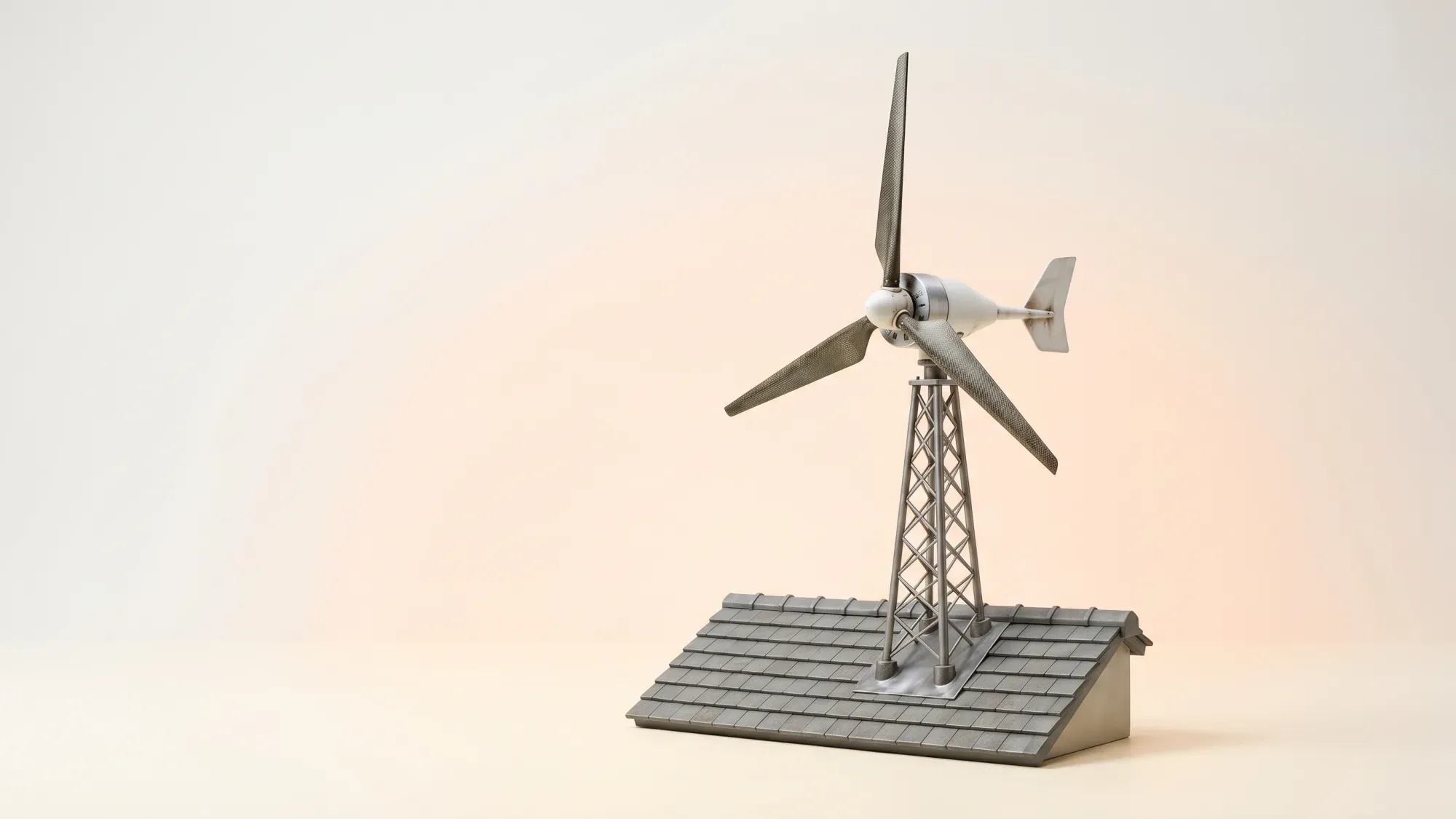
Considering home wind turbines for energy independence and long-term savings? This guide explores the feasibility, costs, regulations, and benefits of home wind power, helping homeowners make an informed decision.
Considering a home wind turbine? While Fuse Energy doesn't install them, we can help you make the most of the electricity they generate with clear pricing and smart energy management tools. Click here to see how Fuse can support your renewable energy journey.
Enter your address to get a quote and see how much you could save
Understanding home wind turbines
Home wind turbines harness the kinetic energy of wind to generate electricity. These systems are designed for residential use, providing a renewable energy source directly at the point of consumption.
How do domestic wind turbines work?
A domestic wind turbine operates on a simple principle: wind turns the blades, which then spin a rotor connected to a generator. This generator converts the mechanical energy into electricity that can be used to power your home, stored in batteries, or even exported to the National Grid. The amount of electricity produced depends on factors such as wind speed, turbine size, and efficiency.
Types of home wind turbines: hawt vs vawt
There are two primary types of home wind turbines:
- Horizontal axis wind turbines (HAWTs): These are the most common design, similar to the large turbines seen in wind farms, with blades that rotate around a horizontal axis. HAWTs are generally more efficient in converting wind energy into electricity, especially in areas with strong, consistent winds, and are self-starting.
- Vertical axis wind turbines (VAWTs): VAWTs have blades that rotate around a vertical axis, making them effective at capturing wind from any direction. They are often considered more suitable for urban or residential settings due to their ability to handle turbulent winds and their components being closer to the ground, which can simplify maintenance. However, VAWTs typically have lower efficiency compared to HAWTs for large-scale power generation.
Assessing feasibility: is your home suitable?
Before investing in a home wind turbine, a thorough assessment of your property's wind resource and site suitability is crucial. Not all locations are equally suited for wind power generation.
Evaluating your property's wind resource
The effectiveness of a wind turbine hinges on consistent and sufficient wind speeds. Wind turbines work best in exposed sites with minimal obstructions like trees or other buildings. A professional site assessment will measure average wind speeds at your property and evaluate potential turbulence, providing a realistic estimate of a turbine's potential output. This assessment helps avoid underestimating the site-specific wind resource and potential electricity generation.
Key site considerations for installation
Several factors influence whether a home wind turbine is a viable option for your property:
- Space: Pole-mounted turbines, which are generally more powerful, require ample open space, often in rural or semi-rural areas. Building-mounted turbines are smaller and attach to the roof, but may not significantly reduce reliance on the grid and can put strain on the building.
- Obstructions: Nearby buildings, trees, or hills can create turbulence and reduce a turbine's efficiency.
- Noise: Turbines generate some noise, which can be a concern for neighbours. Planning regulations often consider noise impact.
- Aesthetics: The visual impact of a turbine is a common consideration, both for homeowners and local planning authorities.
Costs and savings: is a home wind turbine worth it?
The financial viability of a home wind turbine involves understanding the initial outlay, ongoing costs, and the potential for long-term savings on electricity bills.
Initial purchase and installation costs
The cost of a domestic wind turbine varies significantly based on its size and type. Small domestic wind turbines typically range from 1 kW to 6 kW in rated power. A small garden model might be relatively inexpensive, while a larger, pole-mounted system can be significantly more costly, excluding installation. Installation costs for a freestanding turbine can also vary widely, covering labour, materials, and other fees. Roof-mounted turbines may have lower installation costs, but often produce less energy.
Running costs and maintenance
Like any mechanical system, home wind turbines require regular maintenance to ensure optimal performance and longevity. Most turbines need inspections and servicing every one to two years. Maintenance costs can vary depending on the system. This includes checking blades, bearings, gearboxes, and lubrication. A well-maintained wind turbine system can operate for 20 to 25 years, with some manufacturers claiming up to 30 years.
Potential electricity bill savings and payback
A domestic wind turbine can significantly reduce your reliance on grid electricity. A well-positioned 6 kW domestic turbine, for instance, can produce approximately 9,000 kWh per year. This is more than three times the average UK home's electricity consumption of around 2,500 kWh per year1. While a 1 kW turbine might not cover all your electricity needs, a larger system could generate a substantial surplus.
How much electricity can a home wind turbine generate?
A well-located 6 kW domestic wind turbine can produce approximately 9,000 kWh of electricity annually. This is significantly more than the average UK home's electricity consumption, which stands at around 2,500 kWh per year. The actual output depends on wind speeds and site conditions.
Any excess electricity generated can be exported to the National Grid. While self-consumption remains the primary saving, you may be able to earn money through export tariffs, such as the Smart Export Guarantee (SEG), if your system is MCS-certified. However, specific energy savings and payback periods are highly site-specific and depend on factors like wind resource, electricity prices, and the initial investment.
Navigating UK planning permission and regulations
Installing a home wind turbine in the UK involves navigating specific planning permission requirements and grid connection regulations. These can vary by location and turbine characteristics.
Permitted development rights for wind turbines
In England, some domestic wind turbines may fall under "permitted development," meaning they do not require a full planning application, provided they meet strict criteria. These criteria often include limits on height, location, and proximity to boundaries, and require compliance with the Microgeneration Certification Scheme (MCS) Planning Standards. For example, a stand-alone turbine might need to be at least its total height away from any boundary and have blades at least 5 metres above ground level. Building-mounted turbines have even stricter limits, typically not projecting more than 2 metres above the highest part of the roof. However, permitted development rights can be removed in certain areas, such as conservation areas or for listed buildings.
Local authority planning rules
If your proposed turbine does not meet permitted development criteria, or if your property is in a restricted area, you will need to apply for planning permission from your local authority. Planning authorities will consider factors such as visual impact, noise, and the turbine's effect on the surrounding environment and neighbouring properties. It is advisable to contact your local planning officer early in the process.
Grid connection requirements (G98/G99)
Connecting a home wind turbine to the national electricity grid requires notification to your Distribution Network Operator (DNO). This is governed by Engineering Recommendations G98 or G99.
- G98: Applies to smaller microgeneration systems. For these systems, you generally don't need prior DNO approval; you or your supplier must notify them within 28 days of installation.
- G99: Applies to larger systems that exceed the G98 capacity limits. This typically includes more substantial domestic installations. For G99, you need prior DNO approval before connecting your system to the grid.
These regulations ensure the safe operation of your renewable energy system and maintain the stability of the electricity network. Your installer can assist with these notifications on your behalf.
Installation and maintenance considerations
The successful operation of a home wind turbine relies on proper installation and ongoing care.
The installation process
Installing a home wind turbine is a complex process best handled by certified professionals. The steps typically include:
- Site assessment: As mentioned, this is the first crucial step to determine wind resource and suitability.
- Planning and design: Selecting the right turbine type and size, and designing its placement, foundation, and electrical connection.
- Permitting: Securing all necessary planning permissions and grid connection approvals.
- Foundation work: For pole-mounted turbines, a robust foundation is essential.
- Erection: Assembling and erecting the turbine structure.
- Electrical connection: Wiring the turbine to your home's electrical system and the grid, adhering to G98/G99 regulations.
- Commissioning: Testing the system to ensure it operates safely and efficiently.
It is important to use an installer certified under the MCS. MCS certification ensures that both the product and the installer meet rigorous quality and safety standards, and it is often a prerequisite for accessing any financial incentives.
Lifespan, servicing, and upkeep
The typical lifespan of a well-maintained wind turbine is 20 to 25 years, with some lasting up to 30 years. Regular servicing, usually annually or biennially, is vital to achieve this lifespan. This involves:
- Inspections: Checking blades, bearings, and other components for wear and tear.
- Lubrication: Applying grease or oil to moving parts.
- Repairs: Addressing any damage to blades or other components promptly.
While some parts, like gearboxes or blades, may need replacement within the turbine's operational life, routine maintenance helps prevent major issues.
Maximising value with smart energy management
Generating your own electricity with a home wind turbine is a significant step towards energy independence. To truly maximise the value of this self-generated power, integrating it with smart energy management systems is key.
Smart technology, such as smart meters and dedicated apps, can help you monitor your wind turbine's output in real-time and understand your household's energy consumption patterns. This insight allows you to make strategic decisions about when to use electricity, store it, or export it.
Integrating wind power with home systems
By connecting your wind turbine to a smart home energy system, you can:
- Optimise self-consumption: Use appliances during periods of high wind generation to directly consume your own electricity, reducing the amount you need to import from the grid.
- Battery storage: Pair your turbine with a home battery storage system to store excess wind-generated electricity for use when the wind isn't blowing or during peak demand periods. This increases your self-sufficiency and further reduces reliance on grid power.
- Smart appliance control: Program smart appliances to run when your turbine is producing the most electricity, ensuring efficient use of your renewable energy.
Optimising self-consumption with smart technology
Generating your own electricity with a home wind turbine is a fantastic step towards energy independence. Fuse Energy is here to help you manage that power effectively. Our app provides transparent data on your energy usage and generation, helping you optimise self-consumption and potentially reduce your bills. With 24/7 human customer support, we make managing your energy straightforward. Click here to switch to Fuse Energy today and take control of your home's energy. You can also learn more about our mission to make energy abundant here.
References
Disclaimer
For the avoidance of doubt, this article is provided for informational purposes only and is not intended to constitute legal or financial advice. The author and/or Fuse Energy shall not be responsible for any losses arising out of any reliance on the information contained herein.