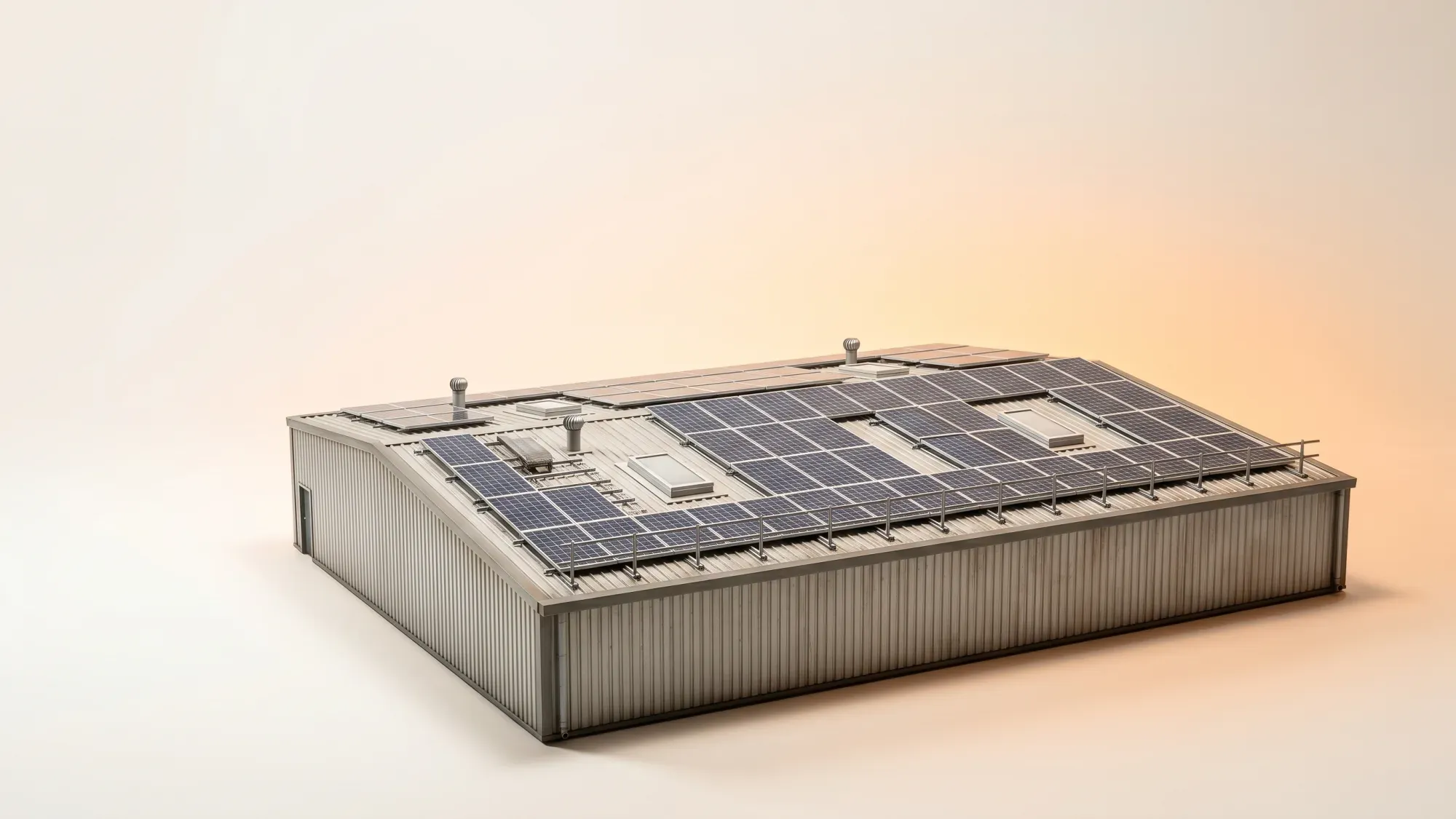
Investing in commercial solar panels is a strategic move for UK businesses looking to gain greater control over their energy costs and enhance their environmental credentials. This guide explores the benefits, financial considerations, and practical steps involved in adopting solar power, aligning with a future where energy is abundant and accessible. Fuse Energy is committed to rebuilding the energy system, and while we do not currently offer commercial solar installation services, we are developing future commercial energy solutions for which businesses can join a waitlist.
Commercial solar offers a clear path to operational efficiency and sustainability, providing businesses with a significant competitive advantage. While Fuse Energy currently focuses on residential energy supply, we are actively developing solutions for commercial customers. Join our waitlist today to be among the first to access our innovative commercial energy offerings when they become available.
Commercial solar installations offer a clear path to operational efficiency and sustainability, providing businesses with a significant competitive advantage.
Reduced operating costs and energy bill savings
Generating your own electricity can significantly reduce your business's reliance on grid power, leading to substantial savings. Commercial solar installations can typically cut a business's electricity bills by 50-70% annually, depending on system size and energy consumption patterns, particularly for retail stores and offices. This provides a buffer against volatile energy prices and contributes directly to the bottom line.
Enhanced energy independence and resilience
By producing electricity on-site, businesses become less susceptible to grid outages and price fluctuations, ensuring a more stable and predictable energy supply. This increased energy independence fosters greater operational resilience, allowing businesses to maintain productivity even when external energy markets are unstable.
Boosting your business's sustainability credentials
Adopting solar power demonstrates a clear commitment to environmental responsibility, improving your business's public image and meeting growing consumer demand for corporate accountability. A 50 kilowatt-peak (kWp) commercial solar system can offset up to 9 tonnes of CO2 emissions per year, contributing to national carbon reduction targets and enhancing your Environmental, Social, and Governance (ESG) scores.
The initial investment in commercial solar is offset by long-term savings and potential revenue streams, making it a sound financial decision for many UK businesses.
Key factors influencing installation costs
The cost of a commercial solar system varies based on factors such as system size, panel efficiency, installation complexity, and roof type. Larger systems often benefit from economies of scale, with costs per kilowatt (kW) decreasing for bigger installations. In 2026, systems typically range from £660 to £1,200 per kW installed.
Calculating your business's solar roi and payback period
The average payback period for a commercial solar system in the UK typically ranges from 5 to 10 years. However, this can be as short as 3 to 6 years for some businesses, influenced by factors such as on-site electricity usage, current energy prices, and available incentives. After the payback period, the electricity generated essentially becomes pure profit for the remaining 20+ years of the system's lifespan.
Long-term value beyond immediate savings
Beyond direct energy bill reductions, commercial solar adds long-term value by increasing property value and providing a reliable energy source for decades. This investment future-proofs your business against rising energy costs and positions it as a leader in sustainable practices.
The UK government offers various schemes and tax reliefs to encourage businesses to invest in solar power, significantly improving financial viability.
Government support schemes and tax relief
Businesses can benefit from substantial tax incentives. The Annual Investment Allowance (AIA) allows businesses to deduct 100% of the cost of qualifying plant and machinery, including solar installations, from their taxable profits up to an annual limit of £1 million. For expenditure exceeding this, Full Expensing (FE) allows companies to claim a 50% first-year allowance on special rate assets like solar panels, with the remaining balance written down over subsequent years.
The Smart Export Guarantee (SEG) for surplus energy
The Smart Export Guarantee (SEG) is a government-backed initiative that enables businesses to sell any surplus electricity generated back to the National Grid. Energy suppliers are mandated to offer SEG tariffs, providing a new revenue stream and enhancing the return on investment for solar installations. To qualify, your system must be certified under the Microgeneration Certification Scheme (MCS) and have a smart meter capable of half-hourly export readings.
Exploring commercial solar financing options
Beyond grants and tax relief, various financing options are available, including green loans and power purchase agreements (PPAs), which can help businesses fund their solar projects with minimal upfront capital. It is advisable to consult with financial advisors to explore the most suitable options for your specific business needs.
A successful commercial solar installation involves careful planning, adherence to regulations, and professional execution.
Initial site assessment and bespoke system design
The process begins with a detailed energy audit and feasibility study of your business premises. Reputable commercial solar providers will conduct a thorough site assessment, considering factors like roof structure, shading, and energy consumption patterns, to develop a bespoke system design tailored to your needs.
Planning permissions and regulatory compliance
While many commercial solar projects fall under permitted development rights, meaning full planning permission is not required, there are exceptions. Planning permission is typically needed for larger systems, ground-mounted arrays, or installations on listed buildings, in conservation areas, or if they significantly alter the property's appearance. Additionally, all installations must adhere to building regulations, ensuring structural integrity and electrical safety. Your installer will also handle grid connection approvals with your Distribution Network Operator (DNO).
Professional installation and system commissioning
Once permissions are secured, professional installers will install and commission your commercial solar PV system. It is crucial to choose installers certified under schemes like MCS, as this ensures quality workmanship and eligibility for incentives. Following installation, a robust monitoring and maintenance plan is essential to ensure optimal long-term performance and savings.
Selecting a qualified and experienced commercial solar partner is paramount for a successful and long-lasting installation.
Accreditation, experience, and track record
Always choose an installer with a strong track record in commercial projects and relevant accreditations. MCS certification is a key indicator of quality and is required for accessing government incentives like the SEG. This certification guarantees that your system will be designed, installed, and commissioned by qualified professionals adhering to strict industry standards.
Comprehensive support, maintenance, and warranties
A reliable installer will offer comprehensive support, including ongoing maintenance and robust warranties for both the panels and the installation itself. This ensures your system operates efficiently throughout its lifespan and provides peace of mind.
Tailored solutions for different business types
Different businesses have unique energy needs and operational structures. A good commercial solar partner will provide tailored solutions, understanding your specific requirements and designing a system that maximises your energy savings and sustainability goals.
Commercial solar is more than just a cost-saving measure; it is a fundamental component of a modern, resilient energy strategy.
Integrating solar with battery storage and EV charging
The future of business energy involves integrating solar power with other technologies. Battery storage systems can store excess solar energy for use during peak demand or at night, further enhancing energy independence. Businesses can also integrate EV charging infrastructure, powered by their solar arrays, to support sustainable transport for employees and fleets.
Preparing for a more decentralised energy landscape
Commercial solar panels position businesses at the forefront of a decentralised energy system, where local generation plays a crucial role. This shift offers greater control over energy resources and reduces reliance on centralised grids, fostering a more secure and sustainable energy future.
Join the waitlist for future commercial energy solutions
Fuse Energy is building future commercial energy solutions designed to empower businesses with abundant, clean power. While we do not currently offer commercial solar installation services, we invite forward-thinking UK businesses to join our waitlist to be among the first to access our innovative commercial energy offerings. Discover our mission and vision for a future with power to play with by clicking here.