Commercial heat pumps for businesses
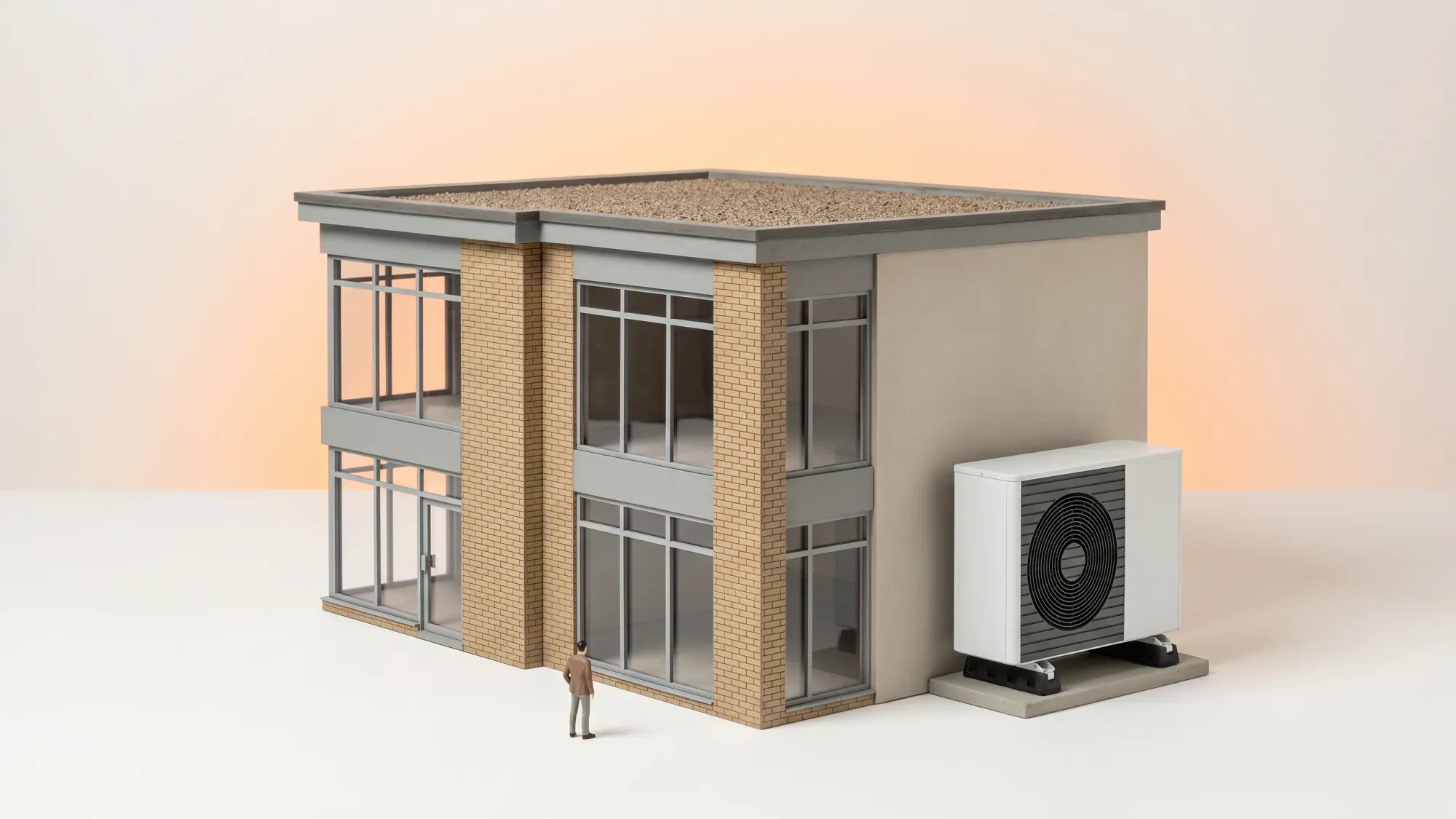
Commercial heat pumps offer UK businesses a compelling way to reduce energy costs and significantly lower carbon emissions, helping to meet net-zero targets. These highly efficient systems extract heat from the environment - be it air, ground, or water - and transfer it to a building's heating infrastructure. For business owners and facility managers, understanding the practicalities, benefits, and financial incentives of adopting this technology is crucial for making informed property decisions.
Understanding commercial heat pumps
Commercial heat pumps are advanced heating and cooling systems designed for non-domestic properties, from offices and retail spaces to warehouses and industrial facilities. Unlike traditional boilers that generate heat by burning fossil fuels, heat pumps simply move existing heat from one place to another.
How commercial heat pumps operate
The fundamental principle behind a heat pump is similar to a refrigerator, but in reverse. It uses a small amount of electricity to transfer a larger amount of heat. A refrigerant fluid circulates through a closed loop, absorbing low-grade heat from an external source (air, ground, or water). This warmed refrigerant is then compressed, which increases its temperature. The hot, high-pressure refrigerant then passes through a heat exchanger, transferring its thermal energy to the building's heating system (e.g., radiators, underfloor heating, or hot water). As the refrigerant cools and expands, the cycle repeats, continuously moving heat into the building.
Air source heat pumps, for instance, can achieve efficiencies of 300% or more, meaning they produce at least 3 kWh of heat for every 1 kWh of electricity consumed. This high Coefficient of Performance (CoP) makes them significantly more efficient than conventional heating systems.
Key components of a commercial heat pump system
A typical commercial heat pump system comprises several core components:
- Heat exchanger: Responsible for absorbing heat from the external environment (air, ground, or water) and releasing it into the building's heating system.
- Compressor: Increases the temperature and pressure of the refrigerant, driving the heat transfer process.
- Expansion valve: Reduces the pressure and temperature of the refrigerant, allowing it to absorb heat again.
- Refrigerant: The working fluid that circulates through the system, absorbing and releasing heat.
- Distribution system: This includes pipework, pumps, and emitters (like underfloor heating or fan coils) that deliver the heat throughout the commercial property.
Types of commercial heat pumps
The suitability of a commercial heat pump system largely depends on the specific characteristics of the property and its surrounding environment. There are three primary types, each utilising a different heat source.
Commercial air source heat pumps
Commercial air source heat pumps (ASHPs) extract heat from the ambient air outside a building. They are generally the most common and often the easiest to install, requiring less extensive groundwork than other types. ASHPs are versatile and can be deployed in a wide range of commercial settings, from offices to retail units and even some industrial facilities. Their efficiency can be influenced by external air temperatures, though modern systems are designed to operate effectively even in colder UK climates.
Commercial ground source heat pumps
Commercial ground source heat pumps (GSHPs) harness the stable temperature of the earth through a network of buried pipes. These systems typically offer higher efficiency and more stable performance compared to air source systems, as ground temperatures are less variable than air temperatures. However, they require more extensive groundworks for installation, which can increase upfront costs and complexity. GSHPs are well-suited for larger commercial properties with available land for trenching or boreholes, such as industrial estates or educational campuses.
Commercial water source heat pumps
Commercial water source heat pumps (WSHPs) draw heat from nearby bodies of water, such as rivers, lakes, or even large industrial water loops. These systems can be exceptionally efficient due to the consistent thermal energy available in water. Installation typically involves submerging heat exchangers in the water source. WSHPs are ideal for commercial properties located close to suitable water bodies, offering a highly effective and stable heating solution.
Benefits for UK businesses
Adopting commercial heat pumps offers a multitude of advantages for UK businesses, aligning with both financial objectives and sustainability goals.
Reduced energy costs and operational savings
By operating with high efficiency, commercial heat pumps can significantly lower a business's energy consumption for heating. This directly translates to reduced operational costs, providing long-term financial savings and greater predictability in energy expenditure. The efficiency is measured by the Coefficient of Performance (CoP), indicating how much heat energy is produced per unit of electrical energy consumed.
Lower carbon emissions and sustainability goals
Switching from fossil fuel-based heating to a commercial heat pump dramatically cuts a business's carbon footprint. The UK government has a legally binding commitment to reach net zero by 2050, with an interim target of a 78% reduction by 2035 compared to 1990 levels. Businesses play a key role in achieving these ambitions, and adopting heat pumps helps meet corporate social responsibility targets and comply with environmental regulations.
Enhanced energy independence and security
Reducing reliance on volatile fossil fuel markets, commercial heat pumps offer greater energy independence. Businesses become less exposed to price fluctuations and supply chain disruptions associated with gas or oil, fostering more secure and stable energy provision for their operations.
Improved building comfort and air quality
Heat pump systems provide consistent and comfortable heating throughout a commercial property. Many systems also offer cooling capabilities, providing a year-round climate control solution. Furthermore, by eliminating on-site combustion, commercial heat pumps can improve indoor air quality by reducing pollutants associated with burning fossil fuels.
Installation and operational considerations
Implementing a commercial heat pump system requires careful planning and consideration to ensure optimal performance and return on investment.
Site assessment and system design
A thorough site assessment is the crucial first step. This involves evaluating the property's heating and cooling demands, insulation levels, existing HVAC infrastructure, and the availability of suitable heat sources (air, ground, or water). An experienced installer will use this data to design a system that is appropriately sized and configured for the specific needs of the commercial building. Failing to conduct a comprehensive assessment can lead to an undersized or oversized system, impacting efficiency and cost.
Integration with existing HVAC infrastructure
Integrating a new heat pump system with existing heating, ventilation, and air conditioning (HVAC) infrastructure is a key consideration. Compatibility with current pipework, radiators, or air distribution systems needs to be assessed to ensure seamless operation and maximise overall efficiency. In some cases, upgrades to the existing infrastructure may be necessary.
Maintenance and long-term performance
Like any complex mechanical system, commercial heat pumps require regular maintenance to ensure optimal efficiency and longevity. This typically includes routine checks, cleaning of filters, and monitoring of refrigerant levels. Establishing a maintenance schedule with a qualified technician is essential to protect the investment and ensure consistent performance over the system's lifespan.
Costs, savings, and UK incentives
Understanding the financial aspects of commercial heat pump adoption is vital for UK businesses.
Upfront investment and potential ROI
The upfront capital investment for commercial heat pump installation in the UK can vary significantly, typically ranging from tens of thousands to hundreds of thousands of pounds. This cost is influenced by factors such as system size, type (air, ground, or water source), property complexity, and any necessary upgrades to existing infrastructure. Despite the initial outlay, the long-term operational savings from reduced energy consumption can lead to a compelling return on investment (ROI) over the system's lifetime.
Government grants and funding for businesses
The UK government offers various schemes and funds to support businesses in decarbonising their operations, which can include grants for commercial heat pump installations. These incentives are designed to encourage the adoption of low-carbon heating technologies and can significantly offset the initial investment. Businesses should investigate programmes such as the Industrial Energy Transformation Fund (IETF) for industrial sites and data centres, the Public Sector Decarbonisation Scheme (PSDS) for public sector buildings, and the Green Heat Network Fund (GHNF) for heat networks. Additionally, Capital Allowances, including Full Expensing and the Annual Investment Allowance, allow businesses paying UK corporation tax to deduct the cost of qualifying plant and machinery, such as heat pumps, against profits. It is important to note that the Boiler Upgrade Scheme (BUS) is for domestic properties only and does not apply to commercial or non-domestic buildings.
Are there government grants for commercial heat pumps in the UK?
Yes, the UK government provides various schemes and funds to support businesses in decarbonising their operations, which can include grants for commercial heat pump installations. These incentives help offset the upfront investment in low-carbon heating technologies.
Long-term financial advantages
Beyond immediate energy savings and grants, commercial heat pumps offer several long-term financial advantages. These include reduced exposure to volatile fossil fuel prices, which can provide greater budgetary certainty. The enhanced energy efficiency can also increase the value of the commercial property and improve its Energy Performance Certificate (EPC) rating, which is becoming increasingly important for property owners and tenants.
Choosing the right system and installer
Selecting the appropriate commercial heat pump system and a competent installer are critical steps for a successful project.
Factors influencing system selection
Several factors should influence the choice of system:
- Property size and heating/cooling demand: Larger properties or those with high energy demands will require more powerful systems.
- Available space: Air source units need outdoor space, while ground source systems require land for collectors.
- Budget: Upfront costs vary significantly between system types and sizes.
- Environmental conditions: Local climate and geology can influence efficiency.
- Integration needs: Compatibility with existing HVAC systems.
The importance of MCS-certified commercial installers
It is paramount to engage experienced, Microgeneration Certification Scheme (MCS)-certified commercial heat pump installers. MCS certification ensures that installers meet high standards of quality and competence. This not only guarantees a professional installation but is also often a prerequisite for accessing government grants and incentives. Using an MCS-certified installer helps ensure optimal system design, performance, and eligibility for support. Fuse Energy is not an MCS-certified installer for heat pumps.
Planning and regulatory compliance
Businesses must also consider building regulations and planning permissions, particularly for large-scale commercial heat pump systems or ground source installations. Local authorities may have specific requirements that need to be met before installation can proceed. Early engagement with planning departments and adherence to all regulatory guidelines will prevent delays and ensure compliance.
Disclaimer
For the avoidance of doubt, this article is provided for informational purposes only and is not intended to constitute legal or financial advice. The author and/or Fuse Energy shall not be responsible for any losses arising out of any reliance on the information contained herein.