Commercial solar panels for UK businesses
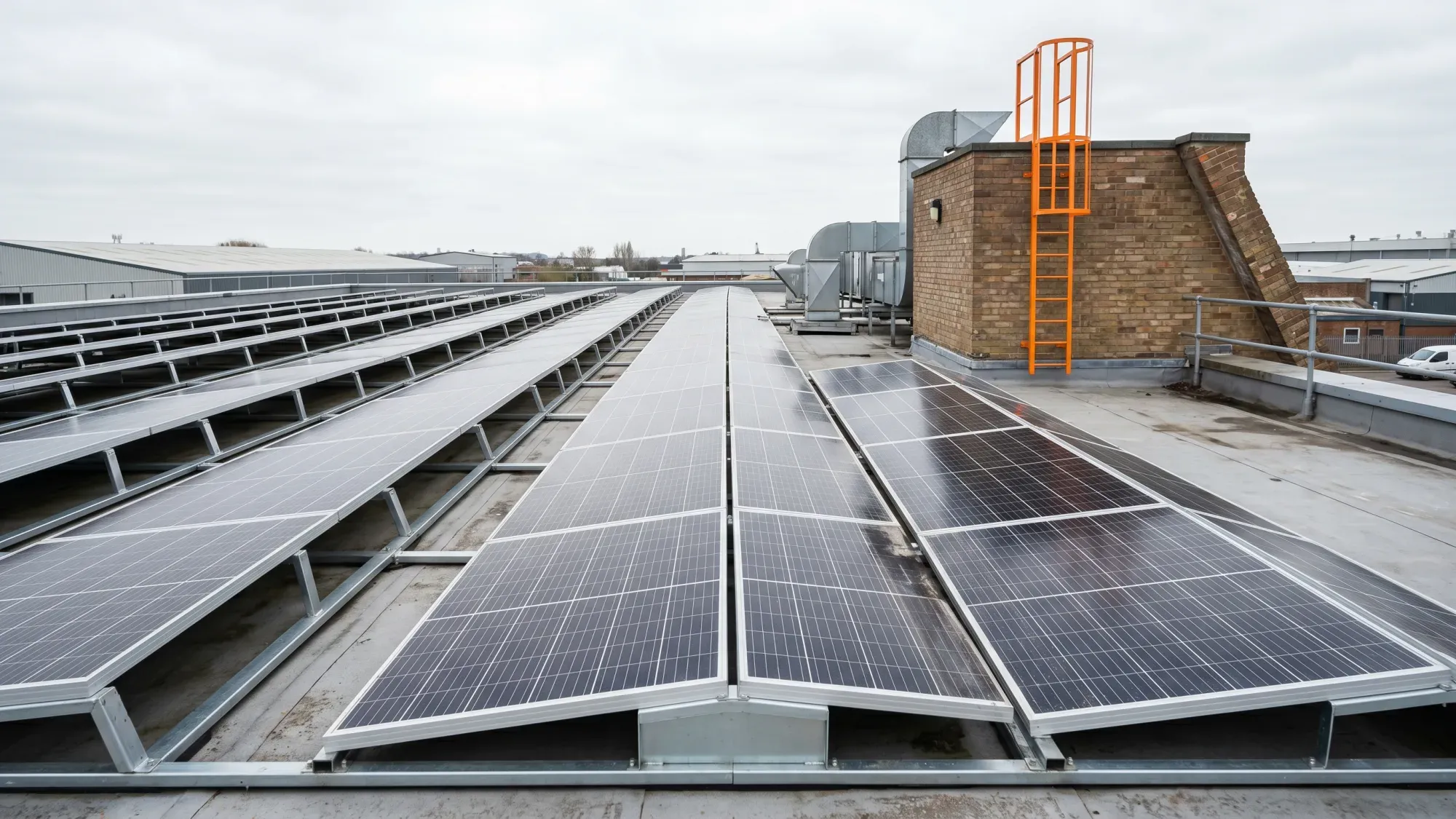
UK businesses are increasingly investing in solar panels to manage rising energy costs and improve their sustainability. This guide explores the benefits, financial considerations, installation process, and future advantages of commercial solar power, helping UK companies make informed decisions for a more resilient energy future.
Considering commercial solar panels for your business? While Fuse Energy currently focuses on residential energy supply, we are actively working towards expanding our offerings to support businesses in their journey towards energy independence. Join our waitlist for future commercial energy solutions.
The strategic advantage of commercial solar panels
Adopting solar photovoltaic (PV) technology offers significant advantages that extend beyond environmental responsibility, providing tangible financial and operational benefits for businesses.
Reducing operational costs
Installing commercial solar panels can lead to a substantial reduction in electricity bills. By generating electricity on-site, businesses lessen their reliance on grid power, directly cutting operational expenses. This is particularly impactful for companies with high daytime energy consumption, as they can offset a significant portion of their electricity needs. Solar panels can reduce electricity bills by 30-70% or more, depending on energy consumption patterns and system size.
Enhancing sustainability and brand image
Investing in business solar panels demonstrates a clear commitment to environmental responsibility. This not only contributes to global sustainability efforts but also enhances a company's brand image, attracting eco-conscious customers, partners, and talent. Businesses can showcase their green credentials, aligning with growing consumer and stakeholder expectations for sustainable practices.
Achieving energy independence
Commercial solar power provides businesses with greater energy independence and control over their operational costs. By generating their own electricity, companies become less susceptible to fluctuating energy market prices and potential grid disruptions, enhancing operational resilience. This strategic move allows businesses to secure a stable, long-term energy supply.
Financial benefits and incentives for businesses
The financial viability of commercial solar projects in the UK is significantly improved by various incentives and the long-term savings they offer.
Understanding return on investment (roi)
Commercial solar panel installations in the UK typically offer a payback period of 5-10 years. Some businesses, particularly those with high energy intensity, may see a return on investment within 3-6 years. The annual return on investment for commercial solar in the UK generally ranges from 10-15%.
What is the typical payback period for commercial solar panels in the UK?
For commercial businesses in the UK, the payback period for solar panel installations typically ranges from 5 to 10 years. However, energy-intensive businesses or those making the most of available tax reliefs can achieve payback in as little as 3-6 years.
Available grants and tax reliefs
The UK government offers several incentives to encourage businesses to adopt solar energy. The Annual Investment Allowance (AIA) allows businesses to deduct 100% of the cost of qualifying plant and machinery, including solar panels, from their profits in the year of purchase. This can significantly reduce the effective cost of a solar investment and shorten the payback period. The AIA limit is currently £1 million per year.
Selling surplus energy with the Smart Export Guarantee (SEG)
The Smart Export Guarantee (SEG) allows businesses to sell any surplus electricity generated by their solar panels back to the grid. This creates an additional revenue stream, further improving the financial viability of a commercial solar installation. Energy suppliers are required to offer SEG tariffs, and businesses can choose the best rate for their exported power.
The commercial solar panel installation process
Implementing a commercial solar PV system involves several key stages, from initial assessment to ongoing maintenance.
Site assessment and feasibility
The first step is to assess your business's energy consumption patterns and the suitability of your site for solar panels. This includes evaluating roof space, structural integrity, and shading to determine the optimal system size and configuration. A thorough feasibility study will provide a clear understanding of potential generation, savings, and the overall project scope.
Navigating planning permission and grid connection
Planning permission requirements for commercial solar installations vary based on factors such as size, location, and building type. While many installations fall under permitted development rights, some may require a full planning application. Additionally, businesses must apply for a grid connection agreement with their Distribution Network Operator (DNO) before installing a commercial solar system. All commercial solar panel installations in the UK must comply with relevant building regulations and electrical safety standards.
Installation and commissioning
Once permissions are secured and the system design is finalised, the installation process begins. This involves mounting the panels, installing inverters, and connecting the system to your business's electrical infrastructure. After installation, the system undergoes commissioning, where it is thoroughly tested to ensure optimal performance and compliance with all safety standards.
Choosing the right commercial solar provider
Selecting an accredited and experienced provider is crucial for a successful commercial solar project.
Accreditation and experience
When choosing a commercial solar provider, look for companies with relevant accreditations, such as Microgeneration Certification Scheme (MCS) certification. This ensures that the installer meets industry standards for quality and competence. A provider with a proven track record and extensive experience in commercial installations can offer valuable expertise and reliable service.
System design and technology
A reputable provider will work with you to design a solar PV system tailored to your business's specific energy needs and site characteristics. They should offer a range of high-quality solar panel technologies and inverters, explaining the pros and cons of each to help you make an informed decision. The design should maximise energy generation and efficiency.
Maintenance and support
Consider the long-term maintenance and support offered by the provider. Regular maintenance is essential to ensure the optimal performance and longevity of your solar panels. A good provider will offer monitoring services and maintenance packages to keep your system running efficiently and address any issues promptly.
Maximising your solar investment
To get the most out of your commercial solar panels, ongoing management and a forward-thinking approach are key.
Monitoring and optimisation
After installation, continuous monitoring of your solar PV system's performance is vital. This allows businesses to track energy generation, identify any potential issues, and ensure the system is operating at peak efficiency. Data-driven insights can help optimise energy consumption patterns to maximise self-consumption and savings.
Future-proofing your business
Investing in commercial solar panels is a step towards future-proofing your business against rising energy costs and increasing environmental regulations. By embracing renewable energy, companies can enhance their long-term sustainability, reduce their carbon footprint, and contribute to a more secure energy future. This proactive approach positions businesses for resilience and continued growth.
Fuse Energy and your business's future
At Fuse Energy, we believe in a future with abundant energy. We encourage businesses to challenge the status quo of rising energy costs by proactively investing in sustainable, long-term energy solutions like solar. Commercial solar offers businesses the capability to generate their own power, reducing reliance on external suppliers and enhancing operational resilience.
While Fuse Energy currently focuses on residential energy supply, our vision extends to empowering businesses with greater energy independence and control over their operational costs. We are building towards offering commercial energy solutions that align with a future of abundant energy. We invite businesses interested in exploring future commercial energy solutions to join our waitlist. This will ensure you are among the first to know when Fuse Energy expands its offerings to support the commercial sector.
Disclaimer
For the avoidance of doubt, this article is provided for informational purposes only and is not intended to constitute legal or financial advice. The author and/or Fuse Energy shall not be responsible for any losses arising out of any reliance on the information contained herein.